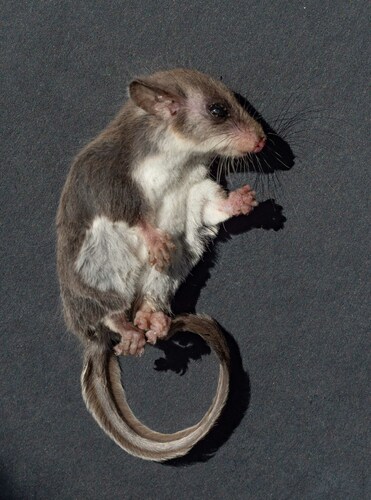
The world's smallest glider is said by some specialists to have a near-twin. In 2015 it was proposed to recognise a second species of feather-tailed glider, set apart from the better-known one by genetic differences not yet published and by subtle features of the toes and tail. That would mean renaming the original species the “Narrow-toed Feather-tailed Glider”, as against this “Broad-toed” one.
Almost identical in appearance to the Narrow-toed Feather-tailed Glider. According to the authors who argue for its separation as a species in its own right, it differs in subtle details of toe shape and tail, based on genetic studies still not formally published.
Strictly arboreal like its sister species, it glides between trees with the help of its feather-shaped tail. It leaves tiny claw marks in tree bark, especially on eucalypts.
Open and closed forest of eastern Australia, within the overall range of the feather-tailed glider complex.
Omnivorous: nectar, pollen and small arthropods such as moths, ants and termites, similar to its sister species.
Strictly arboreal and nocturnal, similar in behaviour to its sister species, the Narrow-toed Feather-tailed Glider, with which it shares much of its range and general ecology.
Because it derives from a widely distributed species complex rated Least Concern, it is provisionally assigned the same category. However, the recent proposal to split it taxonomically, still not formally published, limits the certainty of this assessment.
Loss of forest habitat and of old trees with hollows suitable for shelter.
See all species accounts for kangaroos and koalas · Full species index
Mammaling is a free app for logging the mammals you find. You record a sighting in a moment — even if it's just a track — your life list grows, and the record becomes available to scientific and conservation projects.
It runs on your phone with nothing to install. If you like, it adds to your home screen like any other app.
Open Mammaling