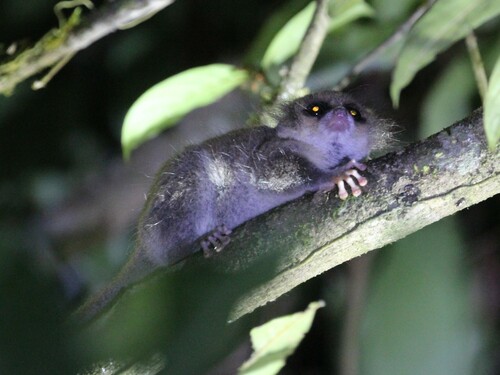
The Hairy-eared Dwarf Lemur is one of the rarest and least known primates on the planet. Confirmed sightings were so scarce that for almost the entire 20th century it was considered probably extinct, until a small group of researchers rediscovered it in the 1980s in a very specific area of eastern Madagascar. Its name comes from the tufts of hair protruding from its ears, a trait no other lemur shares, giving it an almost nocturnal goblin-like appearance. So little is known about its biology in the wild that much of what is known today comes from very few field studies. This makes any confirmed sighting valuable data for its conservation.
The Hairy-eared Dwarf Lemur is a tiny primate, one of the smallest lemurs. It has reddish-brown fur on its back and paler fur on its belly, large eyes adapted for nocturnal vision, and visible tufts of hair protruding from its ears, a unique trait among lemurs. It can be confused with other smaller Dwarf Lemurs and Mouse Lemurs. It is mainly distinguished from them by its ear tufts and a tail that is somewhat less thickened at the base.
A tiny 1.5-2 cm track, with 5 toes and adhesive pads on the tips, is adapted for arboreal movement. It is rarely visible in the field given the rarity of the Hairy-eared Dwarf Lemur (Allocebus trichotis).
Reliable data on the appearance or characteristic location of its droppings are insufficient. The same applies to other specific tracks and signs, given the scarcity and recentness of available field studies on the Hairy-eared Dwarf Lemur.
It shelters in tree hollows during the day, similarly to other Dwarf Lemurs. Its presence has occasionally been confirmed by nocturnal camera trapping rather than by direct tracks and signs.
Lowland and lower montane humid tropical forest, generally below 800 m altitude. Endemic to a very small and fragmented area in northeast Madagascar, one of the most restricted distributions among all lemurs.
The Hairy-eared Dwarf Lemur feeds on tree sap, nectar, fruit, and insects. Its diet is not well known in detail due to the scarcity of field studies on the species.
The Hairy-eared Dwarf Lemur is nocturnal and arboreal. Very little information is available on its social structure and home range. However, it is believed to enter a state of torpor similar to hibernation during the cold, dry season, as do other related dwarf lemurs.
The Hairy-eared Dwarf Lemur is regarded as one of the least known and rarest lemur species in Madagascar. It has very few confirmed localities, and its population is presumed to be small and declining due to continued loss of its forest habitat. However, the scarcity of studies makes it difficult to accurately determine its true status.
The Hairy-eared Dwarf Lemur is threatened by deforestation and fragmentation of the humid forest it depends on. This is exacerbated by the small and scattered nature of the locations where its presence has been confirmed, making the species extremely vulnerable to any further habitat loss.
Full index of mammal species accounts
Mammaling is a free app for logging the mammals you find. You record a sighting in a moment — even if it's just a track — your life list grows, and the record becomes available to scientific and conservation projects.
It runs on your phone with nothing to install. If you like, it adds to your home screen like any other app.
Open Mammaling