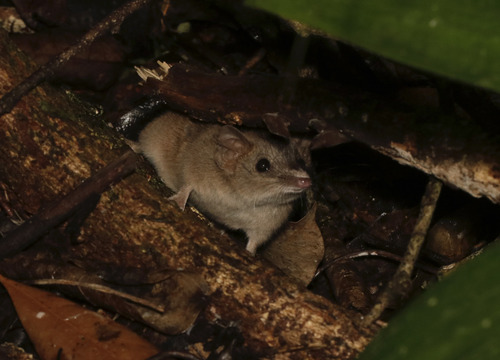
The largest member of the whole “Brown Antechinus complex”, separated as a species in its own right in 2000 after it was confirmed that the subtropical vine forest population between south-eastern Queensland and north-eastern New South Wales was genetically distinct from its more widespread relative.
The largest of the whole Brown Antechinus complex, with a long, narrow snout and a medium brown overall tone. Hard to tell from its close relatives except by these features and by its geographical distribution, restricted mainly to subtropical vine forest.
Digs in the leaf litter of the subtropical vine-forest floor in search of invertebrates, leaving characteristic small patches of disturbed earth.
Subtropical vine forest below 1000 m altitude, from Gympie (Queensland) to the far north-east of New South Wales, with an additional relict population in Dorrigo National Park.
Carnivorous; feeds mainly on insects.
Like the rest of its genus, all males die of stress-related diseases shortly after the mating season.
Species widely distributed within its subtropical vine-forest habitat, with no sign of significant decline.
Loss of subtropical vine-forest habitat to agricultural development.
See all species accounts for carnivorous marsupials · Full species index
Mammaling is a free app for logging the mammals you find. You record a sighting in a moment — even if it's just a track — your life list grows, and the record becomes available to scientific and conservation projects.
It runs on your phone with nothing to install. If you like, it adds to your home screen like any other app.
Open Mammaling