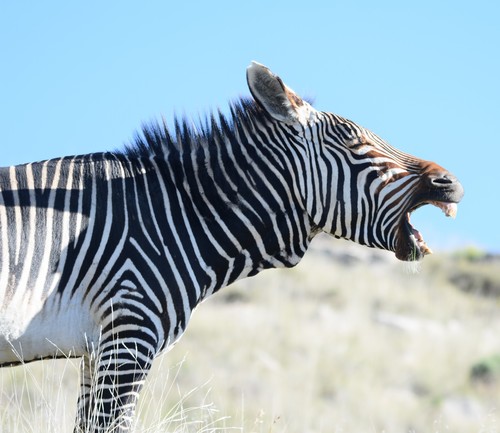
Not all zebras live on the plains seen in documentaries. This species prefers the rocky, arid slopes of south-western Africa, a much more demanding terrain than open savanna. It is distinguished from its more famous relatives by a curious fold of skin under its throat, the dewlap, which no other zebra has. It was on the brink of extinction barely seventy years ago, reduced to fewer than a hundred individuals in one of its populations. Its subsequent recovery is one of the continent's most robust conservation stories.
Medium-sized Mountain Zebra with narrow, closely spaced black stripes on a white background, an unstriped white belly, and a grid-like pattern of stripes on the rump.
It has a visible dewlap under its throat, which is absent in other zebras.
It is distinguished from the Plains Zebra by lacking shadow stripes and by its markedly angular rump.
A rounded, single-toed (hoof) track 8-10 cm long, similar to that of a small horse but somewhat narrower. Droppings in grouped fibrous balls 4-6 cm long, with remains of poorly digested dry grass, scattered along grazing routes. It frequents natural salt licks and dust-bathing areas, which it leaves marked with visible dust wallows.
Arid and semi-arid mountain slopes and rocky plateaus, from lowlands up to over 2000 m.
Distributed in two separate nuclei in south-western Africa: southern South Africa and south-western Namibia and southern Angola, with distinct conservation status between them.
A grazing herbivore, it feeds mainly on tough, low-quality grasses, supplemented with bark and leaves in the dry season.
The Mountain Zebra lives in stable family groups consisting of one male, several females, and their young, while young males form bachelor groups. It requires regular access to water and can travel several kilometres daily between grazing areas and watering holes.
The population in southern South Africa has recovered from fewer than 100 individuals in the mid-20th century thanks to protection in reserves, while that in Namibia and Angola, more numerous but less well-known, remains exposed to poaching.
Poaching, competition for pasture and water with livestock, hybridisation with the Plains Zebra in contact zones, and habitat fragmentation due to agricultural fencing.
See all species accounts for odd-toed ungulates · Full species index
Mammaling is a free app for logging the mammals you find. You record a sighting in a moment — even if it's just a track — your life list grows, and the record becomes available to scientific and conservation projects.
It runs on your phone with nothing to install. If you like, it adds to your home screen like any other app.
Open Mammaling