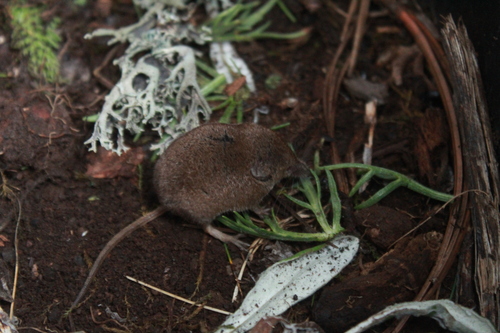
It lives in a handful of isolated mountainous masses of northeast Mexico, each population separated from the others by arid valleys that act as an infranqueable barrier for an animal so little given to move on open and dry ground. Like the rest of musarañas, it has an extraordinary accelerated metabolism that obliges it to feed almost without rest, a biological requirement that limits its presence to the fragments of mountain wet forest where it finds enough invertebrates. Its name pays tribute to an American mastozoologist who documented a good part of the fauna of small mammals of northern Mexico and the east of the United States.
Small-sized musaraches, gray brown fur, long and mobile fox, and tiny eyes barely visible between the fur, are confused with other musaraches from the northern Mexican mountains, whose reliable separation often requires cranial or genetic analysis; their presence in mountainous massifs isolated by desert helps to guide identification.
Minuscule footprint, barely 1-1.2 cm, rarely visible except on very fine substrate. Minuscule, dark excretions, of a few millimeters, with remains of insect cutlery, left scattered by paths under the wet leafy of the mountain forest fragments where he lives. Build surface galleries under the leafy and spherical nests in holes under fallen trunks.
Mountainous forest, in isolated massives surrounded by arid terrain, generally between 2000 and 3000 m of altitude.
Insectívora, it feeds on insects and other invertebrates from the mountain forest soil, caught thanks to a very accelerated metabolism.
Continuous activity distributed in short periods throughout the day and night due to its very accelerated metabolism, with a solitary and territorial behavior.
Its populations are considered to be declining due to the continued loss of mountain wetlands that it depends on, with a fragmented distribution among different isolated massives in northeastern Mexico.
Deforestation and degradation of mountain forests by deforestation and changes in land use, and intrinsic isolation between different mountain populations.
See all species accounts for hedgehogs and shrews · Full species index
Mammaling is a free app for logging the mammals you find. You record a sighting in a moment — even if it's just a track — your life list grows, and the record becomes available to scientific and conservation projects.
It runs on your phone with nothing to install. If you like, it adds to your home screen like any other app.
Open Mammaling