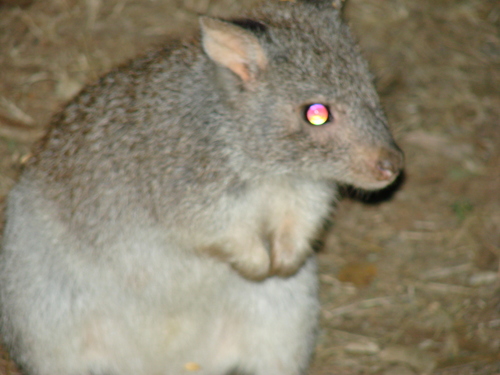
The largest member of the family of potoroos and bettongs, about the size of a rabbit and the only living member of its own genus. It has furry ears, unusual among the hopping marsupials of its group, and a band of coarse whitish hair along the hip that gives it its common name.
The largest of the potoroos and bettongs, with ears covered in hair, unlike most of its bare-eared relatives. The fur is greyish reddish-brown, with a band of coarse, pale hair along the hip that gives it its common name, and the snout is elongated and adapted for digging for food.
Digs small holes in the forest floor in search of underground fungi and tubers, leaving the ground visibly disturbed. Builds nests of woven grass as a daytime refuge hidden in the vegetation.
Open eucalypt forest and adjacent grassland of eastern Australia, from north-eastern Victoria to eastern New South Wales and eastern Queensland.
Omnivorous with a strong mycophagous component: underground fungi, tubers, roots, herbs and occasionally insects.
Nocturnal and solitary. Digs for fungi and tubers with its elongated snout, builds nests of woven grass as a daytime refuge, and can live in relatively open, modified forest.
Widely distributed species rated Least Concern, with no sign of significant decline at global scale.
Predation by foxes and feral cats, and loss of open-forest habitat to agricultural development in some areas.
See all species accounts for kangaroos and koalas · Full species index
Mammaling is a free app for logging the mammals you find. You record a sighting in a moment — even if it's just a track — your life list grows, and the record becomes available to scientific and conservation projects.
It runs on your phone with nothing to install. If you like, it adds to your home screen like any other app.
Open Mammaling