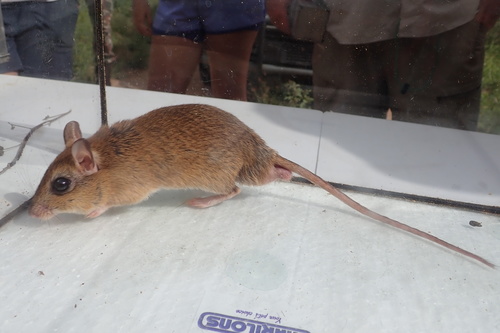
In appearance it is almost a carbon copy of its more widespread relative, the Red Rock Rat. The two species lived for decades under a single scientific name, until the study of their sperm and chromosome number revealed that they are in fact two distinct species that hardly interbreed where they overlap. It lives in southern Africa, in areas with good cover of rocks, scrub and tall grass, where it builds burrows that it shares only occasionally with other individuals.
Medium-sized rodent with reddish-brown fur and a long, sparsely haired tail. Practically indistinguishable by eye from the Red Rock Rat (Aethomys chrysophilus); reliable separation of the two requires genetic or chromosomal analysis, or study of sperm morphology.
Small five-toed track, similar to that of its sister species. Digs burrows in areas with cover of rocks, bushes or tall grass, with mounds of earth at the entrance. Droppings are elongated, 5-8 mm long, and accumulate near the burrows.
Temperate forest, scrub and grassland with good cover of rocks or dense vegetation, in South Africa and Eswatini.
Omnivorous: seeds, fruit, insects and other small invertebrates.
Nocturnal, with a marked preference for areas with abundant cover of rocks, bushes or grass, which it uses as refuge from predators.
The species maintains a large, stable population over most of its range, with no evidence of widespread decline.
Local loss of plant cover through overgrazing, and indirect persecution as an occasional agricultural pest.
See all species accounts for rodents · Full species index
Mammaling is a free app for logging the mammals you find. You record a sighting in a moment — even if it's just a track — your life list grows, and the record becomes available to scientific and conservation projects.
It runs on your phone with nothing to install. If you like, it adds to your home screen like any other app.
Open Mammaling