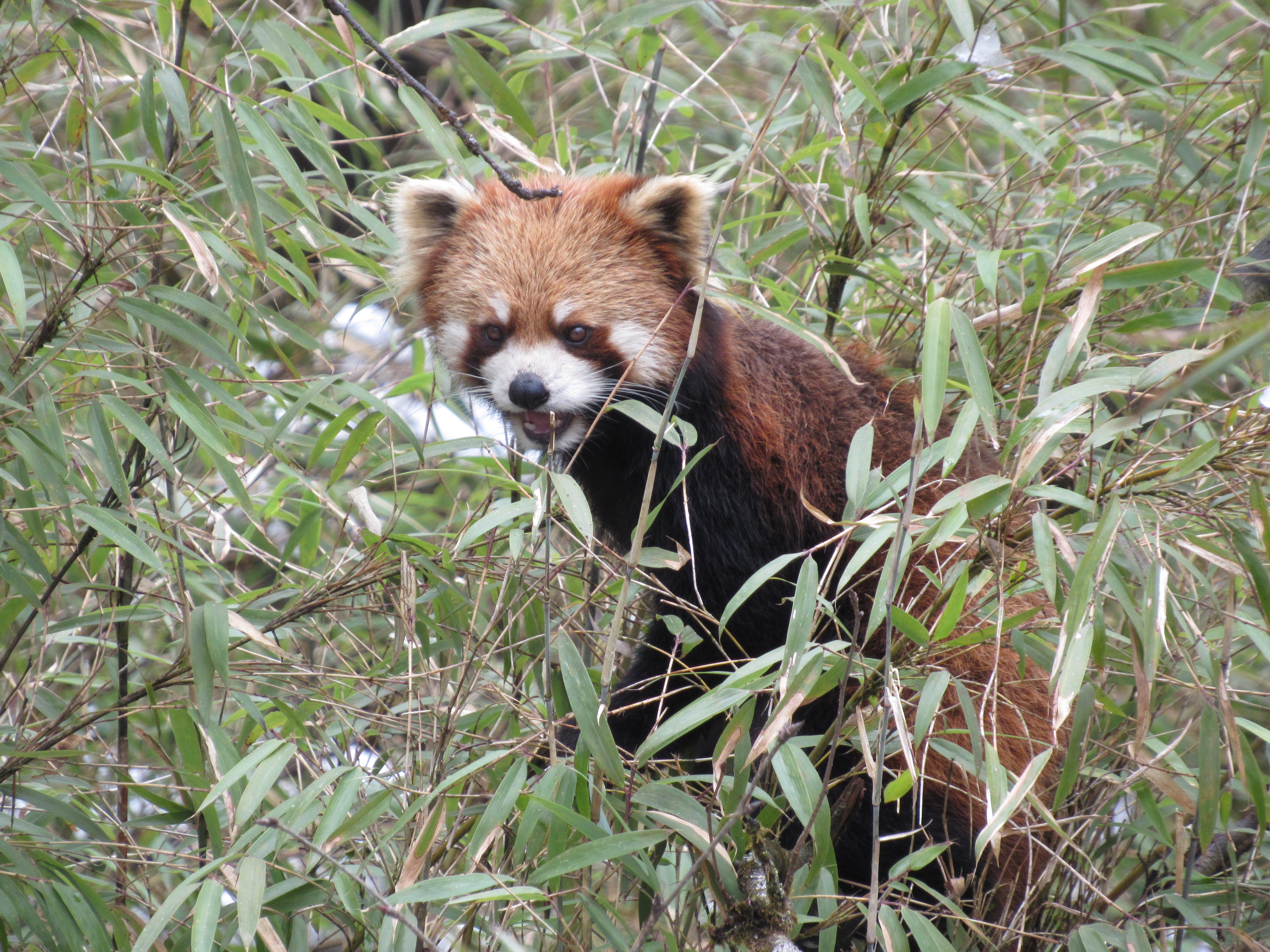
Despite its name and sharing part of its diet, the Western Red Panda is not closely related to the Giant Panda. It is the sole representative of its own family, a lineage so unique that scientists debated for decades whether to classify it with bears, raccoons, or skunks. It lives in the mountain forests of the Himalayas and southern China. There, it spends much of the day sleeping curled up in high branches, with its long, thick tail wrapped around its body like a blanket. Recent genetic studies suggest there are actually two distinct species of Western Red Panda, separated hundreds of thousands of years ago, although official classification still treats them as one.
A mammal the size of a large cat, with intense reddish fur on its back and black on its belly and legs. Its face is white with reddish markings, and it has a long, thick tail banded with light and dark rings.
It is unmistakable within its range: no other arboreal mammal in the region shares that vivid reddish colouring or that ringed tail.
A 5-6 cm track with 5 toes and semi-retractable claw marks. The plantar pad is covered in hair, blurring the outline – an adaptation to cold unusual among carnivores.
Cylindrical, elongated droppings 6-8 cm long, with abundant fibrous remains of barely digested bamboo, left scattered under trees where the Western Red Panda rests.
The Western Red Panda marks its territory with anal gland secretions on rocks and logs, and emits short whistles and chirps when threatened.
Mountain forest with dense bamboo undergrowth, typically between 2200 and 4800 m altitude. Fragmentedly distributed across the Himalayas (Nepal, Bhutan, northern India) and the mountains of southern China and northern Myanmar.
The Western Red Panda feeds almost exclusively on bamboo shoots and tender leaves, supplemented with fruit, roots, eggs, and small invertebrates. Despite this almost vegetarian diet, it retains a carnivorous digestive system that is inefficient at processing cellulose, so it needs to eat large quantities daily.
Solitary and mainly arboreal, active mainly at dawn and dusk, with long rest periods during the day. It defends a home range marked with glandular secretions. The female raises the young alone in a nest built in tree hollows or rock crevices.
Its populations have undergone a steep and continuous decline in recent decades throughout its range, with estimated losses exceeding 50% over three generations. Today, they persist in fragmented and increasingly isolated populations across the Himalayas and southern China.
Loss and fragmentation of bamboo forest habitat due to logging and agricultural and livestock expansion, poaching for the illegal fur and pet trade, and competition with livestock grazing in the undergrowth.


Photographs by Mammaling users, published under a Creative Commons Attribution-NonCommercial licence.
Full index of mammal species accounts
Mammaling is a free app for logging the mammals you find. You record a sighting in a moment — even if it's just a track — your life list grows, and the record becomes available to scientific and conservation projects.
It runs on your phone with nothing to install. If you like, it adds to your home screen like any other app.
Open Mammaling