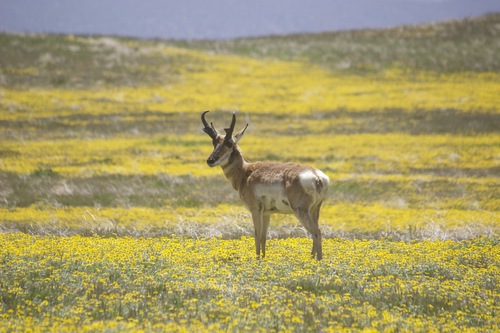
It is the fastest terrestrial mammal of the entire western hemisphere, able to maintain speeds of more than 60 km/h for several kilometers in a row, a capacity that seems disproportionate to current North American predators and that many biologists attribute to an inherited adaptation of when the American guepard, already extinct, travelled the same plains. It is not a true antilope despite its common name: it belongs to a family of its own, without close living relatives on any other continent, and it is the only mammal in the world that changes the outer vault of its horns each year, preserving the permanent bone core below. It lives in prairies and open plains of the western North America, where some populations perform one of the longest documented terrestrial migrations on the continent,
Ungulated medium-sized, red brown fur with the belly, throat and white rabbit very contrasted, and horns with a small forward branch present in both sexes, although much more developed in the male. It differs from any serpent in its area by those permanent horns with mud vaina instead of astes that fall whole, and from other horns by that characteristic forward branch.
Fractured footprint in the shape of a heart, 6-7 cm, with the sharper tips than that of a white tail vein and adapted to open ground and steady prairie. Excrements in the shape of lengthy beetles, 1-1.5 cm, left in lots scattered by open pastoral areas. The most diagnostic signal is the same mud horn vaina, found loose in the soil after the annual mud, hollow and light to the touch, something that no deer of its area leaves losing a massive waist instead of a hollow vaina.
Prairie, steppe and open desert crop, from low lands to mid-mountain heights. Distributed by the west of North America, from southern Canada to the center of Mexico.
Herbivorous, it feeds on grass, bush and herbaceous plant, with a diet that varies greatly depending on the season and regional availability.
Some populations carry out seasonal migrations of several hundred kilometers between summer and winter zones, following traditional corridors very sensitive to infrastructure fragmentation.
Its populations recovered strongly during the twentieth century after the beginning of the century’s lows by unregulated hunting, and today they are generally considered stable in most of their area of distribution.
Fragmentation of traditional migration routes by walls, roads and energy and real estate development, which can block used corridors for generations.
Full index of mammal species accounts
Mammaling is a free app for logging the mammals you find. You record a sighting in a moment — even if it's just a track — your life list grows, and the record becomes available to scientific and conservation projects.
It runs on your phone with nothing to install. If you like, it adds to your home screen like any other app.
Open Mammaling