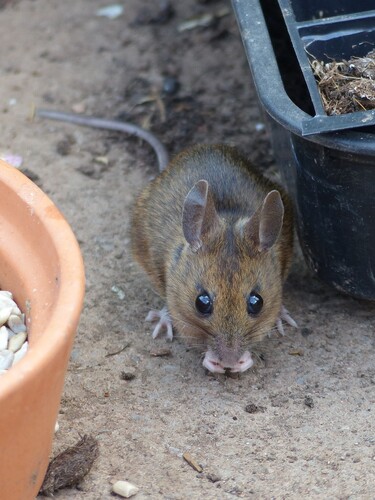
The Long-tailed Field Mouse is probably the most common small rodent in the fields and forests of much of Europe. However, its nocturnal and discreet habits mean that most people never see it, despite constantly encountering its tracks and signs. When threatened, it jumps more than it runs, using long, erratic bounds to confuse predators. This is a striking contrast to the more regular trot of other rodents. It is also a key part of the diet of many European nocturnal predators, from Barn Owls to Weasels. This makes it a discreet but central species for the functioning of the entire ecosystem it inhabits.
Small rodent with reddish-brown fur on its back and pure white on its belly, with a clear demarcation line between the two colours. It has large eyes and ears in proportion to its head, and a long tail, almost as long as its body.
It can be confused with the House Mouse, which is more uniformly greyish and lacks such a marked contrast between back and belly. It can also be confused with the Yellow-necked Field Mouse. The Yellow-necked Field Mouse is larger and has a complete yellow band on its chest, which the Long-tailed Field Mouse lacks.
Tiny track, barely 1-1.5 cm long, with 4 fore toes and 5 hind toes, visible mainly in fine mud or fresh snow. Small, elongated droppings, 4-8 mm long, rice-grain shaped, left scattered along paths and burrows. It builds shallow underground burrows with several entrances and small storage chambers. Caches of seeds, acorns, and hazelnuts, gnawed with a clean, smooth-edged hole, are often found next to stones or logs. This feeding track and sign is very characteristic of the genus.
Forest, hedgerow, scrub, cultivated land and garden, with high tolerance for human-modified habitats, from sea level to mid-mountain areas. Distributed across much of Europe, North Africa and parts of West Asia.
Omnivorous, predominantly eating seeds, nuts and berries, supplemented with invertebrates, shoots and fungi depending on seasonal availability.
Solitary or in small, loosely structured groups. Activity is mainly nocturnal, with breeding peaks in spring and autumn that can overlap in favourable years. It is a key prey item for numerous nocturnal predators, which keeps its populations subject to strong cyclical fluctuations.
It maintains large and stable populations throughout most of its range thanks to its high reproductive capacity and tolerance of modified habitats, with no signs of widespread decline.
Intensive use of rodenticides in agricultural areas directly affects the Long-tailed Field Mouse and harms its predators through bioaccumulation. Also, the loss of hedges and field margins in highly modified agricultural landscapes.
See all species accounts for rodents · Full species index
Mammaling is a free app for logging the mammals you find. You record a sighting in a moment — even if it's just a track — your life list grows, and the record becomes available to scientific and conservation projects.
It runs on your phone with nothing to install. If you like, it adds to your home screen like any other app.
Open Mammaling