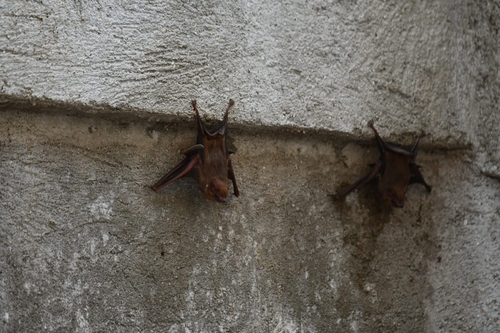
The Gray Sac-winged Bat flies with an erratic pattern and rapid wingbeats, very distinct from the more gliding flight of other bats of its size. It moves in small groups, emerging from its day roosts shortly after sunset to hunt insects in open spaces next to water bodies or vegetation clearings. It lives in caves, rock crevices, and occasionally human constructions in a strip of the Mexican and Central American Pacific coast, where it forms colonies that can reach several hundred individuals grouped on the walls of the roost. It belongs to a family of bats with a characteristic fold in the wing membrane. This feature gives the Gray Sac-winged Bat its name and
The Gray Sac-winged Bat is a small bat with greyish-brown fur, narrow, pointed wings adapted for fast flight, and no nose-leaf. It is distinguished from other small insectivorous bats in its area by its especially fast and erratic flight. It also forms dense, visible colonies on cave walls and rock crevices.
Peak energy frequency is variable, approximately 25-45 kHz, with a downward frequency-modulated (FM) sweep that ends in a quasi-constant frequency (QCF) tail. On a detector screen, this appears as a curved trace falling from high pitches to an almost flat final section. The minimum sweep frequency varies notably with habitat and social context, dropping to 22-
Caves, rock crevices, and human constructions in areas of dry tropical forest and arid scrubland, from lowlands to mid-altitudes. Distributed across the Pacific side of Mexico and Central America.
Insectivorous, it feeds on small flying insects captured in rapid flight over open spaces, often near water bodies.
The Gray Sac-winged Bat forms numerous, dense colonies in caves and rocky crevices. Emergence is highly synchronised, occurring shortly after sunset. Its flight is fast and erratic, very distinct from the slower flight of other insectivorous bats of its size.
Its populations are considered stable throughout most of its home range, with no signs of significant decline.
Disturbance of cave colonies due to tourist or extractive activity, and habitat loss due to deforestation in some areas.
See all species accounts for bats · Full species index
Mammaling is a free app for logging the mammals you find. You record a sighting in a moment — even if it's just a track — your life list grows, and the record becomes available to scientific and conservation projects.
It runs on your phone with nothing to install. If you like, it adds to your home screen like any other app.
Open Mammaling