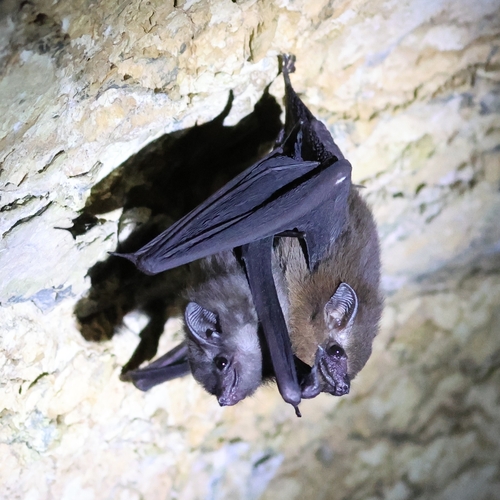
A small bat with fast, direct flight, capable of accurately following the natural corridors formed by streams and paths within the dense forest of insular Southeast Asia.
Small, with smooth, glossy fur ranging from dark brown to reddish, a brown belly, black wings, triangular ears, large eyes and a simple muzzle lacking a noseleaf; forearm 43-45 mm. The short tail retracts into the membrane between the legs when they are extended.
Emits very characteristic narrow-band echolocation calls lasting 6-8 milliseconds, with a constant frequency between 48 and 51 kHz; hunts mainly in dense forest, following corridors formed by streams and paths; roosts in small caves and rock crevices. Tracks and signs include these distinctive acoustic signals.
Forest across Peninsular Malaysia (including Myanmar and Thailand), Borneo and much of the Indonesian archipelago, including Sulawesi, Java and Sumatra.
Insectivorous; hunts mainly in dense forest, and has occasionally been observed eating fruit.
Flies fast and straight thanks to its body shape, following natural forest corridors; it has also been observed foraging by day in areas of dense shade.
A widespread species showing no signs of significant decline.
No major threats identified on a global scale.
See all species accounts for bats · Full species index
Mammaling is a free app for logging the mammals you find. You record a sighting in a moment — even if it's just a track — your life list grows, and the record becomes available to scientific and conservation projects.
It runs on your phone with nothing to install. If you like, it adds to your home screen like any other app.
Open Mammaling