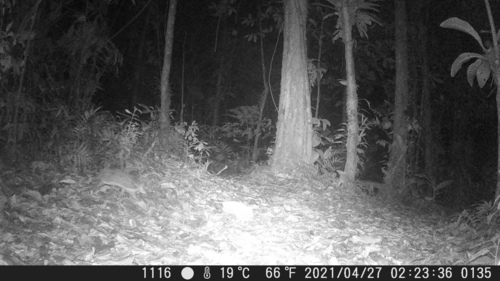
The Northern Naked-tailed Armadillo is a fossorial species, so specialised for subterranean life that its tail, unlike those of other armadillos, almost completely lacks the bony plates that armour the rest of its body. This leaves it naked and flexible, serving as an additional sensory tool underground. It lives in tropical rainforest and transitional forest in Mesoamerica, where it digs deep tunnels in search of ants and termites
A small to medium-sized Northern Naked-tailed Armadillo with a bony carapace covering its back but leaving its tail naked and plate-less, relatively large ears, and very developed, curved fore claws. It differs from other armadillos in its range by its completely naked tail without bony rings – a unique feature of its genus – and by its disproportionately large fore claws adapted for digging.
Tracks show 4-5 toes and very long, deep claw marks 4-5 cm long. These are clearly more pronounced than those of other armadillos of its size, due to its disproportionately large digging claws. Droppings are rarely seen on the surface as they are almost always deposited inside the subterranean burrows. The most diagnostic sign is the burrow itself: an oval entrance 10-15 cm wide with disturbed soil scattered around it, and deep tunnels that can extend several metres under termite mounds or areas with abundant ant activity.
Wet tropical forest and transitional forest, from lowlands to mid-mountain elevations.
Found throughout Mesoamerica, from southern Mexico to northern South America.
A specialised insectivore, it feeds mainly on ants and termites, located and extracted by digging directly into their subterranean nests.
Solitary and almost exclusively subterranean and nocturnal, the Northern Naked-tailed Armadillo spends most of its life digging burrows in search of food. Its reproductive behaviour remains poorly documented given its extremely elusive nature.
Its populations are generally considered stable thanks to its wide distribution and its presence in numerous protected areas. However, knowledge of its true status remains limited. Accelerated deforestation in part of its range could justify a more restrictive re-evaluation in the future.
Deforestation and fragmentation of tropical rainforest due to agricultural and livestock expansion in Mesoamerica.
Full index of mammal species accounts
Mammaling is a free app for logging the mammals you find. You record a sighting in a moment — even if it's just a track — your life list grows, and the record becomes available to scientific and conservation projects.
It runs on your phone with nothing to install. If you like, it adds to your home screen like any other app.
Open Mammaling