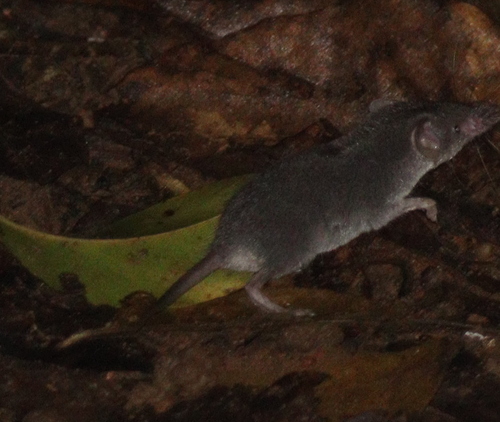
One of the largest shrews in mainland Southeast Asia, described in the same year as another very similar species with which it was confused across much of its distribution for decades.
Relatively large for a shrew in this region. Distinguishing it from other closely related Crocidura species, with which it shares much of its range, often requires cranial examination.
Like other shrews of its size, it leaves subtle tracks and signs that are rarely visible without trapping; it feeds on small invertebrates on the forest floor.
Forest in Cambodia, China, India, Laos, Malaysia, Myanmar, Thailand and Vietnam.
Insectivorous; feeds on small invertebrates.
Shows the almost continuous activity typical of shrews, driven by its high metabolic rate.
Widespread species with no signs of significant decline.
No major threats identified on a global scale.
See all species accounts for hedgehogs and shrews · Full species index
Mammaling is a free app for logging the mammals you find. You record a sighting in a moment — even if it's just a track — your life list grows, and the record becomes available to scientific and conservation projects.
It runs on your phone with nothing to install. If you like, it adds to your home screen like any other app.
Open Mammaling