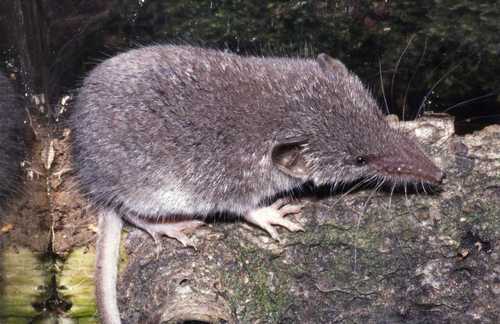
Güldenstädt's White-toothed Shrew is an eastern-distributed shrew. Until relatively recently, it was confused with the European Garden Shrew. Genetic studies revealed it to be a distinct species native to the Caucasus, Anatolia and much of the Near East, with an evolutionary history separated for hundreds of thousands of years.
Like other white-toothed shrews, Güldenstädt's White-toothed Shrew is a tiny hunter with a high metabolism. It needs to feed almost constantly to maintain its body temperature, and uses a strong-smelling musk as a defence against many of its predators.
Its recent taxonomic separation from very similar sister species is a good example of how the true diversity of European and Near Eastern shrews continues to be redefined as genetics advances.
A tiny shrew-like mammal with greyish-brown fur on its back and paler fur on its belly, a long, pointed snout, and white teeth without the reddish tips of shrews in the genus Sorex. It is very similar to other white-toothed shrews in its environment, especially the European Garden Shrew, from which it can only be reliably distinguished by genetic analysis or very precise cranial measurements.
Tiny track, barely 1 cm, rarely visible except on very fine substrate. Tiny, dark droppings, a few millimetres long, with insect chitin remains visible under a magnifying glass, left scattered along its surface runways under vegetation.
It builds spherical nests of dry grass in hollows under stones, walls or fallen logs. Its presence is betrayed by a characteristic musky odour and by a sharp, rapid squeak it emits when communicating or feeling threatened, similar to that of other white-toothed shrews in the region.
Areas of dense vegetation such as scrub, crop edges and rocky areas with vegetation cover, from lowlands to mid-mountain areas. Distributed across the Caucasus, Anatolia and much of the Near East, in a region where its exact distribution is still being refined as genetic studies on the group progress.
An insectivore, it feeds on insects, spiders, and other invertebrates. Its very fast metabolism forces it to feed extremely frequently throughout the day and night.
Continuously active in short bursts throughout the day and night. Generally solitary and territorial outside the breeding season. It secretes a strong-smelling musk from skin glands, which acts as a defence against some predators.
Güldenstädt's White-toothed Shrew maintains generally stable populations throughout its wide range, with no signs of global decline. However, its recent recognition as a distinct species means specific population data remain limited compared to better-studied sister species.
Loss of scrub vegetation and crop margins due to agricultural intensification in some parts of its range, and pesticide use which reduces the availability of invertebrate prey.
See all species accounts for hedgehogs and shrews · Full species index
Mammaling is a free app for logging the mammals you find. You record a sighting in a moment — even if it's just a track — your life list grows, and the record becomes available to scientific and conservation projects.
It runs on your phone with nothing to install. If you like, it adds to your home screen like any other app.
Open Mammaling