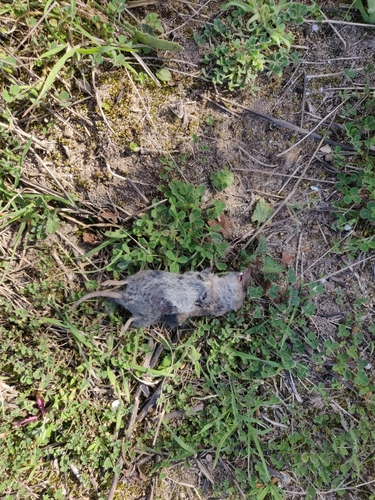
The North African White-toothed Shrew has a surprisingly discontinuous distribution, found on a handful of western Mediterranean islands (including Ibiza, Sardinia, and the small island of Pantelleria) and in North Africa. This scattered pattern probably reflects both its ancient biogeographical history and human-linked introductions in prehistoric or ancient times.
Living in small, isolated island populations, each has evolved to some extent independently over thousands of years. This makes the North African White-toothed Shrew an interesting case study of how island isolation shapes a single mammal lineage in different directions. Relatively little is known about the North African White-toothed Shrew's biology in the wild compared to other better-studied White-toothed Shrews on the European mainland.
A tiny shrew-like mammal, with greyish-brown fur on the back and paler on the belly, an elongated and pointed snout, and white teeth lacking the reddish tips of shrews of the genus Sorex. It is very similar to other Mediterranean White-toothed Shrews, and reliable species-level identification in areas where it co-occurs with close relatives often requires genetic analysis.
Tiny track, barely 1 cm long, rarely visible except on very fine substrate. Tiny, dark droppings, a few millimetres long, with insect chitin remains visible under a magnifying glass, left scattered along its surface runways under dense vegetation. It builds spherical nests of dry grass in crevices under stones or traditional stone walls. Its presence is betrayed by a characteristic musky odour and by a sharp, rapid squeak emitted when communicating or feeling threatened.
Areas of dense vegetation, Mediterranean scrub, and traditional stone walls, from sea level to low mountain areas. Patchily distributed across several Western Mediterranean islands, including Ibiza, Sardinia and Pantelleria, as well as northern Algeria and Tunisia.
Insectivorous, it feeds on insects, spiders and other invertebrates, which it catches due to a very high metabolism that requires it to feed very frequently.
The North African White-toothed Shrew is continuously active in short bursts throughout the day and night. Outside the breeding season, its behaviour is generally solitary and territorial. Its island populations, long isolated from each other, show some degree of differentiation between the various islands it occupies.
The North African White-toothed Shrew is generally considered to be of least concern, given the absence of significant documented pressures on its known island and North African populations. However, the scarcity of specific studies on the species limits precise knowledge of its population trends.
Its very restricted and fragmented distribution in small island populations makes the North African White-toothed Shrew potentially vulnerable to any local habitat alteration. This includes coastal urban development or the introduction of non-native predators on the islands it occupies.
See all species accounts for hedgehogs and shrews · Full species index
Mammaling is a free app for logging the mammals you find. You record a sighting in a moment — even if it's just a track — your life list grows, and the record becomes available to scientific and conservation projects.
It runs on your phone with nothing to install. If you like, it adds to your home screen like any other app.
Open Mammaling