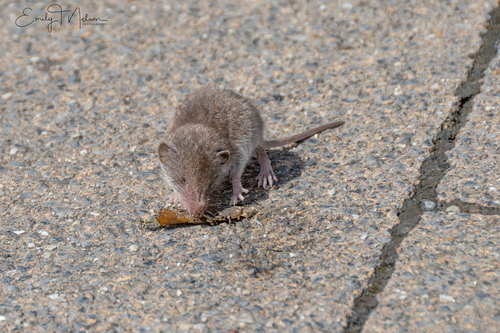
The Greater White-toothed Shrew is a tiny, voracious hunter. It needs to eat several times its own weight in insects every day just to keep pace with a soaring metabolism. This metabolism is so high that it can barely survive more than a few hours without food.
Despite its mouse-like appearance, the Greater White-toothed Shrew has no close relation to rodents. It belongs to a completely different group, the shrews, which are more closely related to moles.
Its presence is often detected by smell rather than sight. This is because it secretes a strong-smelling musk that deters many of its potential predators, though not all.
A tiny, mouse-like mammal with a very long, pointed snout ending in a mobile nose. Its small eyes are almost hidden in the fur, and its ears are visible, unlike those of other shrews. It has white teeth, lacking the characteristic reddish tips of *Sorex* shrews.
It differs from true mice by its pointed snout and lack of characteristic rodent incisors. It differs from red-toothed shrews by the uniform white colouring of its dentition.
Tiny track, barely 1 cm long, rarely visible except on very fine substrate. Tiny, dark droppings, a few millimetres long, with insect chitin remains visible under a magnifying glass, left scattered along its paths under vegetation. It builds spherical nests of dry grass in hollows under stones, fallen logs, or stone walls. Its presence is often betrayed by a characteristic musky odour. It also emits a sharp, rapid squeak, almost a trill, when communicating or feeling threatened.
Areas of dense vegetation such as hedges, stone walls, gardens, cultivated fields, and scrubland, with a strong association with human-made structures in many regions, from sea level to mid-mountain areas. Distributed across south-western Europe and North Africa.
Insectivorous, the Greater White-toothed Shrew feeds on insects, spiders, worms and other invertebrates. Its very accelerated metabolism forces it to feed extremely frequently throughout the day and night.
It is continuously active, with short periods of activity and rest throughout the day and night. Outside the breeding season, its behaviour is generally solitary and territorial. It secretes a strong-smelling musk from skin glands, which acts as a defence against some predators.
It maintains large and stable populations throughout much of its range thanks to its high reproductive capacity and its tolerance of human-modified habitats, with no signs of widespread decline.
Use of pesticides and insecticides in agricultural environments, which reduces prey availability, loss of traditional hedges and stone walls in the rural landscape, and mortality from predation by domestic cats in peri-urban areas.
See all species accounts for hedgehogs and shrews · Full species index
Mammaling is a free app for logging the mammals you find. You record a sighting in a moment — even if it's just a track — your life list grows, and the record becomes available to scientific and conservation projects.
It runs on your phone with nothing to install. If you like, it adds to your home screen like any other app.
Open Mammaling