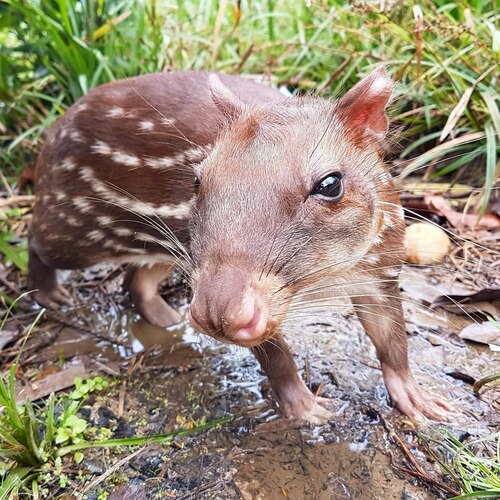
The Lowland Paca is one of the most sought-after rodents by subsistence hunters throughout tropical America, and for good reason: its meat is highly prized, and its size makes it a substantial quarry. With a robust body mottled with pale spots that break up its silhouette in the vegetation, it spends the day hidden in burrows near watercourses, emerging at night to feed in the undergrowth. It has a cranial feature unique among rodents: bony resonating chambers on the sides of the skull that amplify the sounds it emits, although their exact function remains under study. Along with agoutis, it is one of the main dispersers of large tropical tree seeds.
It is 60-80 cm in body length and weighs 6-12 kg, with a large head, short, rounded ears, and relatively short legs. Its fur is reddish-brown with rows of white spots arranged longitudinally along the body, a pattern that clearly distinguishes the Lowland Paca from any other rodent of its size in its home range. It differs from the Agouti (Dasyprocta), with which it often coexists, in its larger size, more robust body, and rows of pale spots, which are absent in Agoutis.
The Lowland Paca leaves tracks with four toes on the fore feet and five on the hind feet, 5-6 cm long, with a well-marked central plantar pad. These differ from Dog tracks by the absence of elongated claw marks and by a more rounded, compact pattern.
It digs burrows along river and stream banks, with several entrances 20-30 cm in diameter, often under tree roots or on embankments. Droppings are rounded, 1-2 cm long, and are usually deposited near burrow entrances. Remains of gnawed fruits with wide incisor marks are often found on the forest floor, a common sign of the Lowland Paca's nocturnal feeding activity.
Humid tropical forests and gallery forests, always near rivers, streams, or bodies of water, from sea level up to about 2000 m, from central Mexico to northern Argentina.
It feeds on fallen fruit, seeds, tender leaves and roots, and plays an important role as a seed disperser of large trees in tropical forest.
The Lowland Paca is nocturnal and solitary, spending the day sheltered in burrows near water, from which it can escape by swimming if pursued. It is territorial and defends a foraging area, which it may share to a limited extent with its mate. The female usually gives birth to a single young per litter, very well developed at birth.
Lowland Paca is one of the most important subsistence hunting prey species in tropical America, which maintains constant hunting pressure. However, its wide distribution and relatively rapid reproductive capacity allow it to sustain stable populations throughout most of its range.
Subsistence and commercial hunting for meat consumption, along with deforestation of the tropical rainforest, are the main threats to the Lowland Paca.
Full index of mammal species accounts
Mammaling is a free app for logging the mammals you find. You record a sighting in a moment — even if it's just a track — your life list grows, and the record becomes available to scientific and conservation projects.
It runs on your phone with nothing to install. If you like, it adds to your home screen like any other app.
Open Mammaling