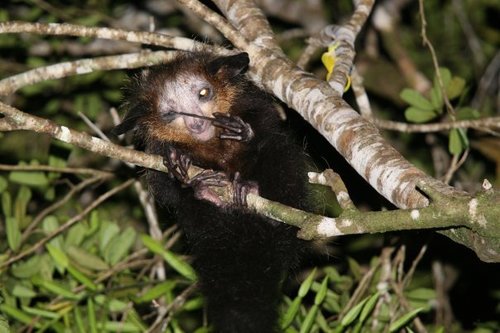
It is probably the strangest-looking primate on the planet, so distinct from any other lemur that early European naturalists who examined it spent years debating its taxonomic placement.
It has a skeletal and extraordinarily long middle finger, which it uses as a precision tool, tapping wood to detect larvae-occupied cavities by echo and then extracting them with that same finger. This is a hunting technique no other primate employs
A medium-sized primate, with fur black to dark brown, white tufts on the face, large, membranous ears, enormous orange-yellow eyes adapted for nocturnal vision, and a long, very bushy tail. The Aye-aye is unmistakable due to its skeletal middle finger, which is much thinner and longer than the other fingers. No other primate in the world shares this feature.
Hand track, 6-8 cm long, with 5 digits; the middle digit is notably thinner and longer than the rest. It has claws, not the typical flat nail plates of other lemurs.
It leaves repetitive tapping marks on the bark of trunks and branches. This percussive behaviour is used to locate larvae by the echo, which is audible at a certain distance.
It builds large spherical nests of branches and leaves in high tree forks, up to half a metre in diameter. It changes these nests frequently. It also leaves deep gnaw marks in the wood where it has extracted larvae.
Lowland humid tropical forest and dry deciduous forest, from sea level to mid-mountain areas. Endemic to Madagascar, with a very wide but fragmented distribution throughout the island.
The Aye-aye is an omnivore, specialising in wood-boring insect larvae. It locates these by percussion and extracts them with its elongated middle finger. Its diet also includes seeds, fruit, and nectar. It extracts coconut pulp using its incisors, which grow continuously like a rodent's.
Solitary and strictly nocturnal, the Aye-aye has a large home range that may overlap with those of several individuals of the opposite sex. It frequently builds a new nest, rarely using the same one two nights in a row, and its reproduction does not follow a strict seasonal pattern.
Its populations have suffered a continuous decline in recent decades. This is due to forest loss and direct persecution, as local beliefs associate the Aye-aye with bad luck. However, its wide distribution across the island has so far allowed it to avoid a situation as critical as that of other Malagasy lemurs.
Loss and fragmentation of forest due to logging and slash-and-burn agriculture, hunting and direct killing due to local superstitious beliefs, and occasional capture for the illegal wildlife trade.
Full index of mammal species accounts
Mammaling is a free app for logging the mammals you find. You record a sighting in a moment — even if it's just a track — your life list grows, and the record becomes available to scientific and conservation projects.
It runs on your phone with nothing to install. If you like, it adds to your home screen like any other app.
Open Mammaling