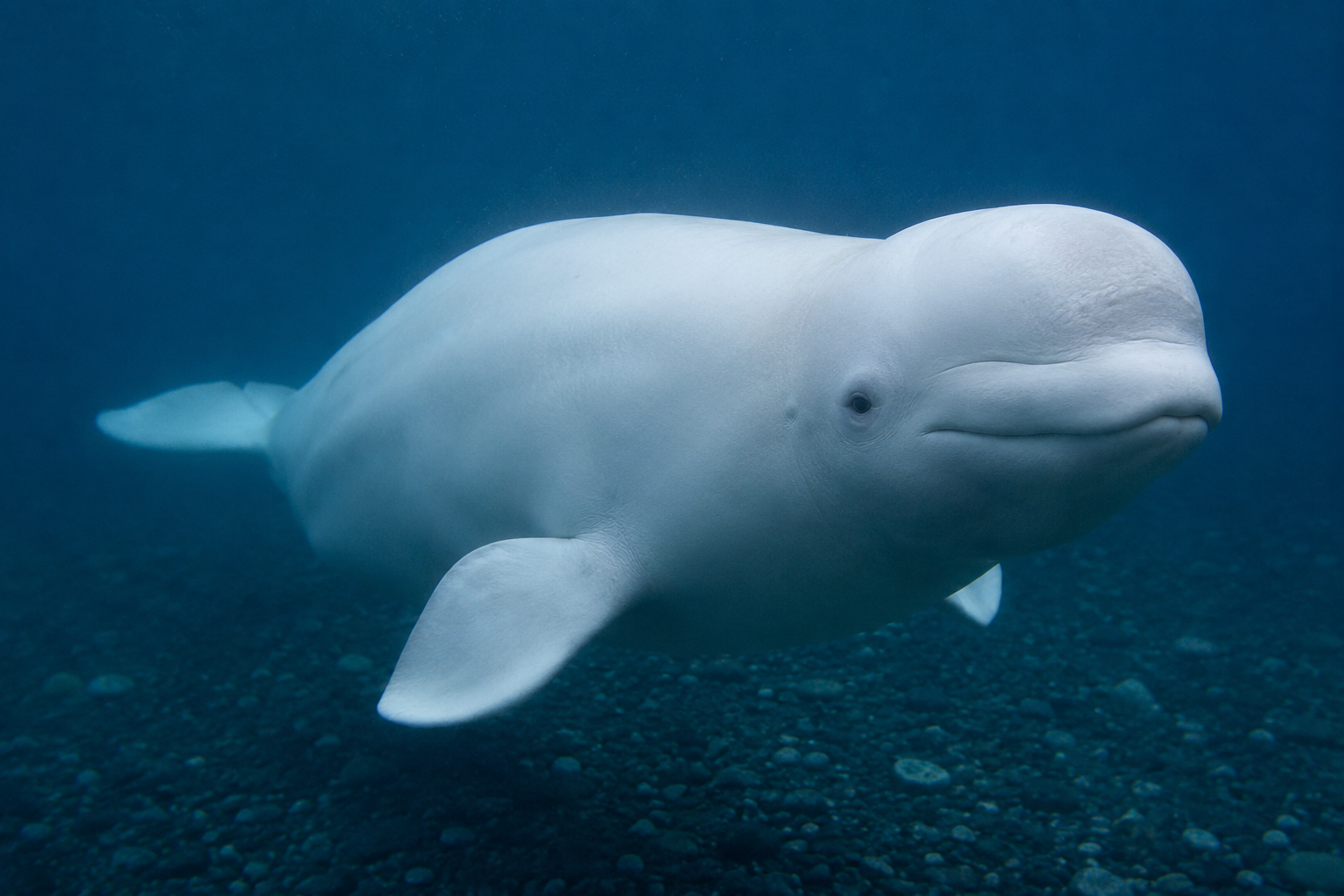
The Beluga is one of the few cetaceans able to move its neck freely. Unlike almost all dolphins and whales, its cervical vertebrae are unfused, allowing it to turn its head from side to side like a terrestrial mammal.
Its ivory-white colouring, acquired only after several years of life, and its varied, audible repertoire of whistles, clicks, and trills, make the Beluga one of the most recognisable cetaceans in the Arctic. Early sailors nicknamed it the 'sea canary' due to these sounds.
Each summer, the Beluga sheds its entire skin by rubbing against pebbly bottoms in shallow estuaries. This behaviour is not shared by any other cetacean and greatly complicates assessing the status of its most isolated populations.
Medium-sized cetacean with a robust, plump body, ivory white in adults and bluish-grey in juveniles. It has no dorsal fin and a prominent, rounded frontal 'melon' which can change shape when vocalising.
The Beluga cannot be confused with any other cetacean in its range, due to its uniform white colouring and complete absence of a dorsal fin. This trait is shared only with the Narwhal, which is mottled greyish and has the characteristic tusk in males.
The Beluga leaves no tracks on land. It is detected by a low, inconspicuous blow, followed by a smooth emergence of its rounded, finless back. This is very distinct from that of any other Arctic cetacean. It is extremely vocal, with a repertoire of whistles, clicks, and trills audible even from the water's surface or through a boat's hull, which facilitates its acoustic detection. In summer, it forms aggregations in shallow, pebble-bottomed estuaries where it is observed rubbing its body against the substrate to shed old skin, a moulting behaviour that leaves yellowish skin shreds floating in the area.
Coastal Arctic and sub-Arctic waters, estuaries, bays, and seasonal sea ice zones, with movements towards river estuaries in summer for moulting.
Circumpolarly distributed throughout the Arctic, with highly fragmented populations and conservation status varying greatly by region.
Carnivore feeding on fish such as Capelin and Arctic Cod, as well as crustaceans and other benthic invertebrates, caught by deep diving under sea ice.
Highly social, the Beluga lives in groups of variable composition that can gather hundreds of individuals in summer moulting areas. It undertakes seasonal movements between winter feeding areas in open sea or under ice and shallow estuaries in summer. Its strong dependence on seasonal sea ice conditions much of its migratory behaviour.
The situation varies greatly depending on the subpopulation. Most Arctic populations remain relatively numerous. However, the Cook Inlet subpopulation in Alaska has been assessed separately in a much more critical threat category following a very pronounced decline, with no clear signs of recovery despite legal protection.
Seasonal sea ice loss due to climate change, which alters their migratory routes and access to feeding grounds; bycatch in fishing gear; heavy metal pollution, which accumulates in coastal populations near industrialised areas; and underwater noise from maritime traffic and industrial activity.
Full index of mammal species accounts
Mammaling is a free app for logging the mammals you find. You record a sighting in a moment — even if it's just a track — your life list grows, and the record becomes available to scientific and conservation projects.
It runs on your phone with nothing to install. If you like, it adds to your home screen like any other app.
Open Mammaling