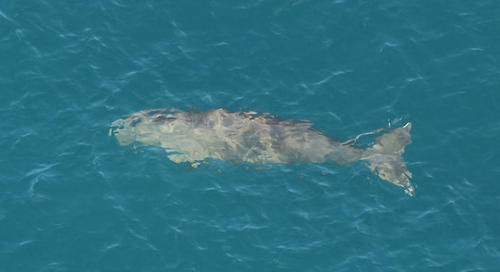
The Dugong is the only strictly herbivorous marine mammal, feeding almost exclusively on seagrass meadows. Its grazing creates distinct trails excavated in the seabed, visible even from the air.
It is credited with being the origin of many mermaid legends told by sailors across the Indian and Pacific Oceans. However, its stout appearance and downward-pointing snout, adapted for grazing, bear little resemblance to a romantic mermaid.
It lives in warm, shallow coastal waters throughout the Indo-Pacific, but its extreme dependence on seagrass meadows – an increasingly degraded habitat – makes it a highly reliable indicator of the health of these coastal ecosystems.
A large sirenian with a greyish, fusiform body. It has a large, downward-pointing snout with a thickened, flexible upper lip adapted for plucking plants from the seabed. Its crescent-shaped tail fluke, similar to a whale's, distinguishes it from the Manatee, whose tail is rounded and paddle-shaped. Adult males develop small, visible tusks, which are absent or poorly developed in females.
It leaves no terrestrial tracks. The most characteristic tracks and signs are feeding trails: excavated and cleared strips several metres long in seagrass meadows, visible in shallow, clear water and even from the air. The Dugong can also be detected by a brief, soft blow when surfacing to breathe, much less visible than a whale's. Occasionally, high-pitched whistle and squeak vocalisations are heard underwater, used for communication between mother and young.
Warm, shallow, sheltered coastal waters with seagrass meadows, generally less than 10 m deep. Widely but fragmentedly distributed across the Indian Ocean and western Pacific, from East Africa and the Red Sea to northern Australia and the western Pacific islands. Its status varies greatly by region.
Almost exclusively herbivorous, the Dugong feeds on seagrasses, which it uproots from the seabed with its flexible upper lip, leaving characteristic feeding trails in the meadows.
Usually solitary or in small family groups, though it can form larger aggregations in highly productive feeding areas. The female has a very slow reproductive rate, with a single young every 3-7 years. This makes the Dugong especially vulnerable to any increase in adult mortality.
The situation varies enormously by region: the Dugong maintains relatively numerous populations in northern Australia. However, in much of the rest of its range, including East Africa, it has suffered very pronounced declines due to seagrass meadow loss and bycatch. In East Africa, a subpopulation has been separately assessed in a much more critical category.
Bycatch in fishing gear, degradation and loss of seagrass meadows due to pollution and coastal development, collision with boats, and direct hunting in some areas where the tradition of hunting it persists.
Full index of mammal species accounts
Mammaling is a free app for logging the mammals you find. You record a sighting in a moment — even if it's just a track — your life list grows, and the record becomes available to scientific and conservation projects.
It runs on your phone with nothing to install. If you like, it adds to your home screen like any other app.
Open Mammaling