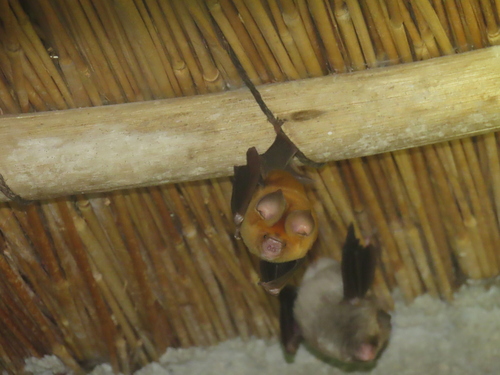
Sundevall's Roundleaf Bat forms some of the largest colonies of any bat in the world: up to 500,000 individuals have been counted in a single cave in Gabon. It emits an extremely high-pitched echolocation call, close to 140 kHz and well above the limit of human hearing, which it uses to detect insects even in dense vegetation. Its gestation is unusually prolonged by seasonally delayed embryonic implantation, lasting up to nearly 100 days in southern Africa.
Medium-sized bat, 8-9 cm long, with a horseshoe-shaped noseleaf and an additional projection on each side. Large, rounded ears with a well-developed antitragus. Pelage can exhibit two colour phases. It differs from other leaf-nosed bats in the region by the size and structure of the noseleaf.
Tracks and signs: emits a nearly constant frequency (CF) pulse lasting about 6 milliseconds, with most of the energy concentrated near 140-145 kHz (variable up to ±15 kHz), followed by a short frequency-modulated (FM) downward sweep. On a detector screen, it appears as a very fine horizontal line at the top of the spectrum, with a short slanting tail at the end. It can be confused with other rhinonycterids of similarly high frequency; known distribution and colony size help rule out alternatives. The roost is another clear sign: it forms colonies of hundreds to hundreds of thousands of individuals in caves, tree hollows and buildings, often shared with other bat species, leaving large accumulations of guano beneath the perch.
Savannah, woodland and farmland, from sea level up to mountain areas, across a broad mosaic in sub-Saharan Africa, the Arabian Peninsula and North Africa.
Nocturnal flying insects, especially moths, caught along the edge of vegetation.
Forms colonies of highly variable size, ranging from small family groups to hundreds of thousands of individuals. Gestation is delayed by seasonal deferred embryonic implantation, extending the apparent period up to nearly 100 days in some populations.
The species maintains a very broad and large population across most of its range, with no evidence of widespread decline.
Human disturbance of breeding colonies in caves through tourism and local religious ceremonies, although this is not considered a serious threat to the species as a whole.
See all species accounts for bats · Full species index
Mammaling is a free app for logging the mammals you find. You record a sighting in a moment — even if it's just a track — your life list grows, and the record becomes available to scientific and conservation projects.
It runs on your phone with nothing to install. If you like, it adds to your home screen like any other app.
Open Mammaling