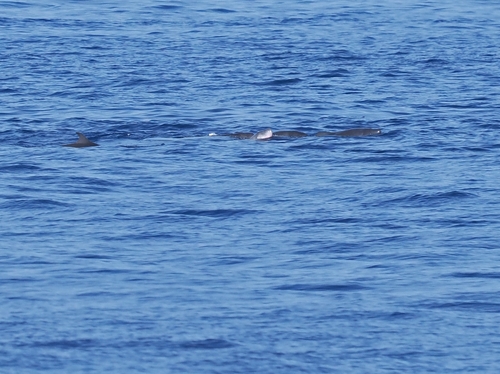
The Dwarf Sperm Whale is the smaller of the two miniature sperm whale relatives. It is so discreet and elusive at sea that most of what is known about its biology comes from dead animals stranded on beaches, not from sightings in the wild. It shares an unusual defensive trick among cetaceans with its slightly larger relative: when threatened, it expels a cloud of dark intestinal fluid, similar to squid ink, to confuse predators while diving away. Its dorsal fin, which is higher and more centrally placed than its relative's, is, along with its slightly smaller size, the best feature for differentiating the two species when they are stranded on the same beach.
The Dwarf Sperm Whale is a small cetacean, somewhat smaller than its better-known relative. It has a robust body, dark bluish-grey on the back and lighter on the belly. Its head is square with a small, recessed lower jaw, and a pale mark behind the eye resembles a shark's gill slit. It differs from the Pygmy Sperm Whale in its somewhat smaller size. Its dorsal fin is proportionally larger and situated further towards the centre of the back, unlike its relative's smaller, more recessed fin.
The Dwarf Sperm Whale leaves no tracks on land. Its behaviour at sea is extremely discreet, with a low, barely visible blow and a slow surfacing that rarely clearly shows its back. This makes it very difficult to detect even at close range.
When threatened, it can release a defensive cloud of dark intestinal fluid, similar to squid ink. This behaviour is shared with its relative and is its most characteristic sign of behaviour.
The vast majority of records for the species come from beach strandings, where its square head, recessed jaw, and high, centrally placed dorsal fin allow it to be differentiated from its larger relative.
The Dwarf Sperm Whale inhabits deep oceanic waters of the continental shelf and slope, in warm temperate and tropical waters worldwide. It is rarely observed near the coast except when stranded.
Widely distributed globally, with very few direct records at sea due to its elusive behaviour.
It feeds primarily on deep-water squid, supplemented with benthic fish and crustaceans, caught during deep dives.
Solitary or in small, loosely cohesive groups, the Dwarf Sperm Whale's very discreet and elusive behaviour on the surface makes its direct study at sea extremely difficult. Its reproductive and social biology remains poorly understood compared to other better-studied cetaceans.
Due to its elusive behaviour and the fact that most records come from strandings, there is an almost complete lack of direct population data for the Dwarf Sperm Whale. This makes it impossible to reliably determine global population trends.
Ingestion of plastic and other marine debris, relatively frequently documented in necropsies of stranded animals, bycatch in deep-sea fishing gear, and underwater acoustic pollution that can interfere with its echolocation.
See all species accounts for even-toed ungulates · Full species index
Mammaling is a free app for logging the mammals you find. You record a sighting in a moment — even if it's just a track — your life list grows, and the record becomes available to scientific and conservation projects.
It runs on your phone with nothing to install. If you like, it adds to your home screen like any other app.
Open Mammaling