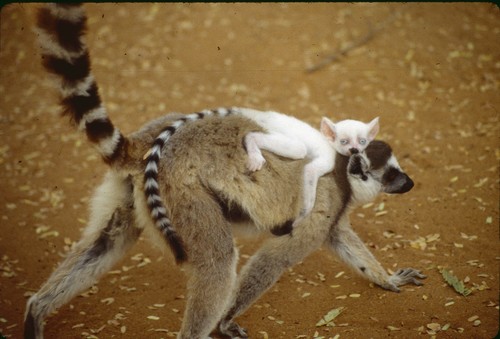
The Ring-tailed Lemur is probably the most recognisable lemur in the world, thanks mainly to its long, black-and-white striped tail. It carries this tail erect like a flag when moving on the ground. This behaviour is unusual among lemurs, which are typically much more arboreal.
Unlike most primates, the Ring-tailed Lemur lives in female-led societies. Females dominate males in access to food and in almost all group decisions.
Its image is now one of the most widely used to represent Madagascar worldwide. This popularity contrasts painfully with the rapid and recent decline of its wild populations.
The Ring-tailed Lemur is a medium-sized primate with grey fur on its back and white on its belly. Its face is white, with a black mask around the eyes and a black muzzle. It has a very long tail with alternating black and white rings, which it carries erect when walking. It is unmistakable within its range due to its characteristic ringed tail, which no other lemur possesses.
Forefoot and hindfoot tracks each have 5 digits. The hindfoot track shows a well-developed opposable first digit. Tracks are 6-8 cm long and are more frequently found than those of other lemurs due to the Ring-tailed Lemur's more terrestrial habits. Irregular droppings, containing fruit and vegetable fibre, are left scattered on the ground throughout the home range.
The Ring-tailed Lemur marks its territory by applying secretions from glands on its wrists and chest to branches and trunks. During oestrus, males rub their tail with these secretions. They then wave the scented tail towards rivals in a behaviour known as scent combat.
Dry deciduous forest, gallery forest and thorny scrub, with an unusually high tolerance among lemurs for moving on the ground. Endemic to southern and south-western Madagascar, with a fragmented and rapidly declining distribution.
Omnivorous, with a diet predominantly of fruit, supplemented with leaves, flowers, bark, and occasional invertebrates. Its highly flexible diet allows it to adapt to the seasonal availability of the dry forest.
Ring-tailed Lemurs live in mixed groups of several males and females, with a female-led hierarchy. Females have priority over males in access to food.
The Ring-tailed Lemur moves on the ground more frequently than most lemurs. Males often compete for status through tail-waving scent fights rather than direct physical aggression.
Its populations have undergone a very sharp and rapid decline in the last decade, with estimates suggesting a loss of most of the wild population in a relatively short period. This has led to a significant worsening of its threat status in the most recent assessments.
Deforestation and degradation of dry forest result from logging, charcoal production, and livestock grazing. Other factors are hunting for local consumption and the capture of young for the illegal pet trade, both within Madagascar and abroad.
Full index of mammal species accounts
Mammaling is a free app for logging the mammals you find. You record a sighting in a moment — even if it's just a track — your life list grows, and the record becomes available to scientific and conservation projects.
It runs on your phone with nothing to install. If you like, it adds to your home screen like any other app.
Open Mammaling