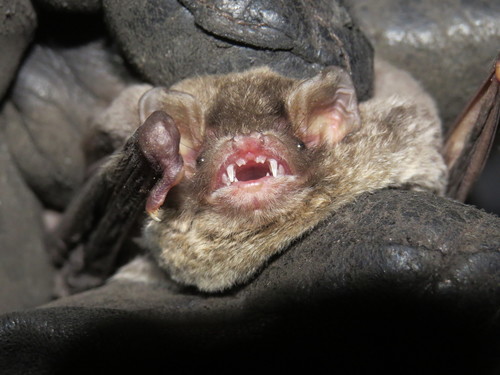
Schreibers's Long-fingered Bat is one of the most gregarious bats, forming breeding colonies of tens of thousands of individuals packed into a single cave. These are some of the largest known mammal concentrations anywhere in the world. It has very long, narrow wings adapted for fast, sustained flight. This allows it to travel tens of kilometres each night between its roost and foraging areas, much further than most European bats. It depends entirely on specific caves for breeding and hibernation. A handful of caves across its distribution range thus become a critical resource, as an enormous proportion of the species' global population relies on them.
Schreibers's Long-fingered Bat is a small to medium-sized bat with uniform greyish-brown fur, a very characteristic domed forehead, and short, rounded ears almost hidden in the fur. Long, narrow wings give it a fast, direct flight, very different from the more erratic flight of other bats of its size. It differs from other cave bats by its domed forehead and the shape of its wings, which are adapted for long-distance flights.
It leaves no identifiable terrestrial tracks and signs. Droppings are small and friable, 5-8 mm long, accumulated in massive quantities beneath breeding colonies on cave floors, sometimes forming guano layers several centimetres thick. At night, Schreibers's Long-fingered Bat emits relatively high-frequency echolocation pulses while hunting in fast, sustained flight. In caves with large colonies, a continuous murmur generated by tens of thousands of individuals can be heard from outside.
Caves and abandoned mines with stable temperature and humidity for breeding and hibernation. Schreibers's Long-fingered Bat hunts in a wide variety of open and wooded habitats within a wide radius around the roost.
Distributed across Southern Europe, North Africa and parts of Asia, from lowlands to mid-mountain areas.
Insectivorous, it hunts moths and other flying insects in fast, sustained flight, often at considerable height and far from the roost.
Extremely gregarious, Schreibers's Long-fingered Bat forms breeding and hibernation colonies that can reach tens of thousands of individuals in a single cave, often shared with other bat species. It makes seasonal movements between summer breeding caves and winter hibernation caves, which can be separated by tens or hundreds of kilometres.
Its populations have suffered a notable decline in several regions of its home range in recent decades, especially documented in some of the large colonies in southern Europe. This is particularly concerning given that a very high proportion of the global population depends on a small number of specific caves.
Disturbance and destruction of cave colonies occur due to caving tourism and mine exploitation. Cave entrances are also subject to closure or alteration. The use of pesticides reduces its insect prey. Furthermore, the extreme concentration of the population in a small number of critical roosts makes Schreibers's Long-fingered Bat very vulnerable to specific disturbance events.
See all species accounts for bats · Full species index
Mammaling is a free app for logging the mammals you find. You record a sighting in a moment — even if it's just a track — your life list grows, and the record becomes available to scientific and conservation projects.
It runs on your phone with nothing to install. If you like, it adds to your home screen like any other app.
Open Mammaling