It has a tongue up to 60 cm long, which can flick in and out of its mouth more than 150 times per minute. This tongue is covered in sticky saliva, capable of trapping thousands of ants and termites in a single feeding session. These sessions rarely last more than a minute at each nest, just long enough to avoid massive stings before the Giant Anteater moves to the next.
The Giant Anteater is the largest of the anteaters and one of the most anatomically specialised mammals in the Americas. It has not a single tooth in its entire mouth. Its fore claws are so large that it walks on its knuckles to avoid damaging them against the ground.
Despite its imposing appearance, the Giant Anteater is a shy, slow-moving animal. If threatened, it prefers to stand on its hind legs and use its enormous claws for defence rather than flee or actively attack.
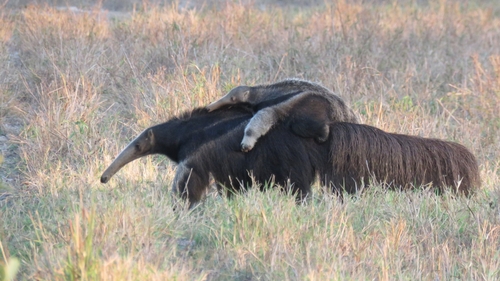
A large, unmistakable mammal. Its elongated body is covered in thick, greyish fur, marked by a diagonal black stripe bordered with white across its flank. It has a very elongated, tubular snout, lacking teeth. It possesses a long, very bushy tail, used as a blanket when sleeping.
Its tubular snout and distinctive tail make it unmistakable among other mammals in its range.
The fore track is very distinctive, showing marks of only 2-3 toes. The full plantar pad is not supported, as the Giant Anteater walks on its knuckles to protect its claws. This pattern is not shared by any other mammal of its size in the region. In contrast, the hind track supports the full plantar pad with 5 toes.
Droppings are soft, with hardly any visible solid remains, as the Giant Anteater feeds almost exclusively on crushed insects.
The clearest tracks and signs of its presence are torn ant nests and termite mounds. These have a characteristic hole, opened with the fore claws, which is much cleaner and more localised than the damage left by a bear or Wild Boar searching for the same food.
Savanna, grassland, gallery forest and open tropical forest, from lowlands to mid-mountain areas. Distributed across much of Central and South America, from Honduras to northern Argentina, though now extinct in much of its historical Central American range.
A specialised myrmecophage, the Giant Anteater feeds almost exclusively on ants and termites. It locates these by smell and extracts them from their nests with its fore claws and a very long, sticky tongue, changing nests every few minutes to avoid completely depleting any colony.
Solitary and primarily terrestrial, the Giant Anteater has a large home range which it roams in search of scattered ant and termite nests. It sleeps wrapped in its own long, bushy tail like a blanket. The female raises a single young, which she carries on her back for several months.
The Giant Anteater has suffered a documented decline of at least 30% in the last decade, due to a combination of habitat loss, roadkill and fires. This, along with confirmed local extinctions in several areas of its range, has recently led to an elevation of its threat category.
Habitat loss due to agricultural and livestock expansion, increasingly frequent and intense forest and savanna fires, roadkill along roads traversing its territory, and local hunting in some regions.
See all species accounts for sloths and anteaters · Full species index
Mammaling is a free app for logging the mammals you find. You record a sighting in a moment — even if it's just a track — your life list grows, and the record becomes available to scientific and conservation projects.
It runs on your phone with nothing to install. If you like, it adds to your home screen like any other app.
Open Mammaling