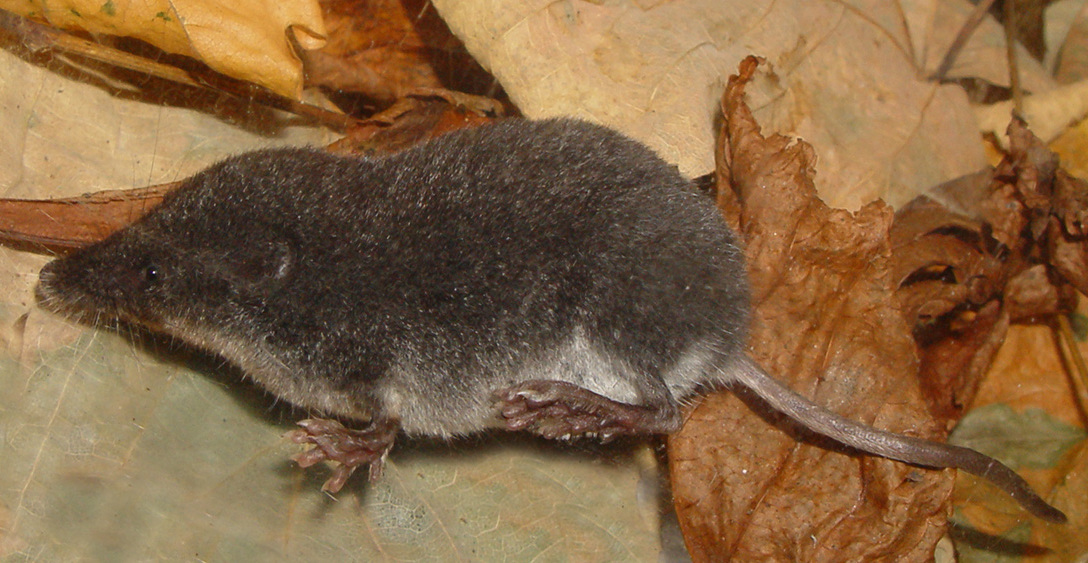
The Mediterranean Water Shrew is the result of a recent taxonomic split. Until a few years ago, this species and the Eurasian Water Shrew of the rest of Europe were considered a single, widely distributed species, until genetic analysis revealed differences marked enough to treat them as distinct species, leaving this population restricted to the Mediterranean region. Like other shrews of its genus, it possesses a mildly venomous bite—produced by a neurotoxin in its salivary glands—which allows it to overpower prey relatively large for its tiny size, as well as semi-aquatic habits that keep it bound to fresh water. Described so recently, much of its biology and exact distribution is still being documented.
A small shrew-like mammal with dark brown fur on the upperparts and paler underparts, a long, mobile snout, and a fringe of stiff hairs on the edge of the feet adapted for swimming. It is virtually indistinguishable at first sight from the Eurasian Water Shrew from which it was split recently; reliable species-level identification requires genetic analysis or geographical context within its Mediterranean range.
Tiny track, barely 1-1.5 cm long, visible mainly in fine mud near water, showing marks from the fringe of hairs on the feet. Tiny, dark droppings a few millimetres long, containing aquatic insect chitin fragments visible under a magnifying glass, deposited scattered along banks. It digs short burrows into banks with entrances just above or at water level, a pattern shared with other water shrews of its genus.
Banks of streams, ponds and wetlands in the Mediterranean region, from lowlands to mid-altitude mountain areas. Distributed across the Mediterranean region, with its range still being defined following its recent taxonomic split from the Eurasian Water Shrew of the rest of Europe.
Carnivorous, feeding on aquatic and terrestrial invertebrates, small amphibians and tadpoles caught during short, active dives, often incapacitated by the mildly venomous bite characteristic of the genus.
Solitary and territorial, with activity spread over short periods throughout the day and night owing to its very high metabolic rate. Described so recently, many details of its social and reproductive behaviour have yet to be studied separately from its former sister species.
Generally considered unthreatened within its known Mediterranean range, though a lack of specific studies following its recent taxonomic split limits precise knowledge of its population trends.
Pollution and drainage of Mediterranean wetlands, canalisation of watercourses which removes bankside vegetation, and predation by introduced species such as the American Mink in certain areas.
See all species accounts for hedgehogs and shrews · Full species index
Mammaling is a free app for logging the mammals you find. You record a sighting in a moment — even if it's just a track — your life list grows, and the record becomes available to scientific and conservation projects.
It runs on your phone with nothing to install. If you like, it adds to your home screen like any other app.
Open Mammaling