Described in 2020, Ticul's Gray Shrew was identified based on genetic differences found in desert shrews of the Baja California Peninsula and southern California. This species reveals the extent to which Crawford's Shrew, considered for over a century to be a single widespread species, actually concealed several lineages separated by the Colorado River.
It lives in the Baja California desert and adjacent areas, divided into several recognised subspecies within the peninsula and on San Martín Island.
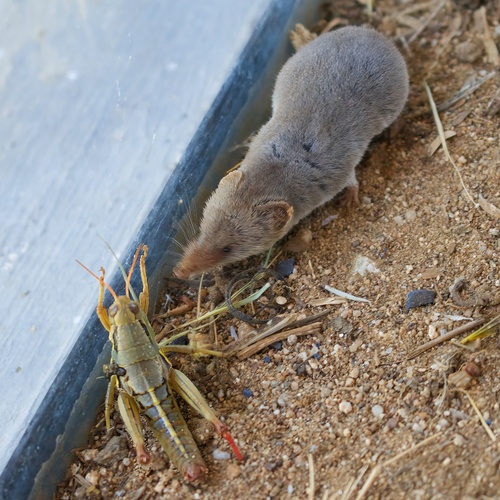
Tiny, Ticul's Gray Shrew is practically identical in appearance to other shrews of the genus Notiosorex. It has grey-brown fur, a pointed snout, and very small ears.
There is no reliable external feature to distinguish it from N. crawfordi or other species of the genus. Its identification depends on genetic and cranial analyses.
Like the rest of the genus, Ticul's Gray Shrew's minimal weight means it rarely leaves recognisable tracks except in very fine dust. Droppings, cylindrical, 3-4 mm long and containing arthropod remains, are the most accessible sign but indistinguishable to the naked eye from those of other desert shrews in the area.
Ticul's Gray Shrew occupies shelters already built by other animals, such as Field Vole mounds or the base of dense shrubs.
Deserts of the Baja California peninsula, southern California, and San Martín Island.
Insects and other soil arthropods, like the rest of the genus.
Solitary and nocturnal. There are no specific published data on its reproduction, which is assumed to be similar to other Notiosorex species.
Described in 2020, Ticul's Gray Shrew does not yet have its own assessment on the IUCN Red List; its true conservation status is currently unknown.
Specific assessed threats are unknown; however, by analogy with other desert shrews, urban and tourist development on the Baja California peninsula could affect part of its habitat.
See all species accounts for hedgehogs and shrews · Full species index
Mammaling is a free app for logging the mammals you find. You record a sighting in a moment — even if it's just a track — your life list grows, and the record becomes available to scientific and conservation projects.
It runs on your phone with nothing to install. If you like, it adds to your home screen like any other app.
Open Mammaling