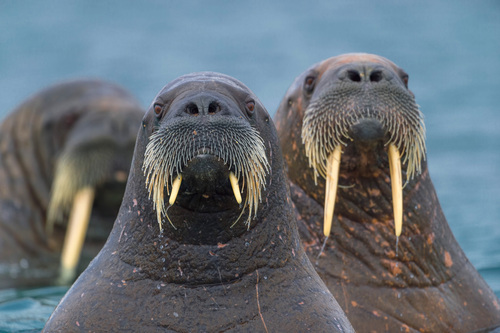
The Walrus is unmistakable among all marine mammals due to its long tusks. These are actually hypertrophied upper canines, which it uses both for fighting and defending territory, and for hauling itself out of the water onto ice. This hauling technique gives the species its scientific name, *Odobenus rosmarus*.
It lives in the icy waters of the Arctic, where it spends much of its time resting in large aggregations on blocks of sea ice or on rocky beaches. They pile one on top of another, creating a memorable scene for first-time observers.
Its dependence on sea ice for resting between feeding dives makes it one of the Arctic species most directly affected by global warming. This is drastically reducing the available ice surface in much of its home range.
A large pinniped with thick, wrinkled skin, reddish-brown to pink in colour depending on water temperature. It has a small head relative to its body, very thick, sensitive whiskers, and a pair of long tusks present in both sexes, more developed in males. It is unmistakable: no other marine mammal has comparable tusks.
It does not leave tracks in the usual sense, but rather very wide, deep drag furrows on pebble beaches or ice, often with parallel marks left by the tusks as it hauls itself out of the water. Droppings are liquid and rarely found on land.
The most reliable sign of its presence is large aggregations of individuals resting very close together on ice or rock. Another sign is a characteristic underwater tapping and bell-like sound during oestrus, produced by air sacs in the male's throat.
Shallow Arctic coastal waters with access to mollusc-rich seabeds and sea ice or rocky beaches for resting between dives. Circumpolarly distributed across the Arctic, with two recognised major populations, one in the Atlantic and one in the Pacific, widely separated.
The Walrus feeds mainly on bivalve molluscs, which it locates on the seabed using its sensitive whiskers, sucking the flesh from inside the shell. Occasionally, it may prey on Seals.
Highly gregarious, the Walrus forms large resting aggregations of hundreds or thousands of individuals on sea ice or rocky beaches. Its social structure is based on hierarchies related to tusk size.
It undertakes seasonal movements, following the advance and retreat of sea ice, on which it depends to access its feeding grounds.
Projections of Arctic sea ice loss associated with climate change predict a future decline of the Walrus, as the ice platforms it uses to rest between dives are reduced. This forces it to concentrate in fewer terrestrial resting areas, increasing the risk of stampedes and young mortality.
Loss of sea ice due to climate change reduces their resting areas and alters access to their feeding grounds. Other threats include increased maritime traffic and industrial activity in the Arctic, and episodes of mass mortality from stampedes in very dense terrestrial aggregations.
Full index of mammal species accounts
Mammaling is a free app for logging the mammals you find. You record a sighting in a moment — even if it's just a track — your life list grows, and the record becomes available to scientific and conservation projects.
It runs on your phone with nothing to install. If you like, it adds to your home screen like any other app.
Open Mammaling