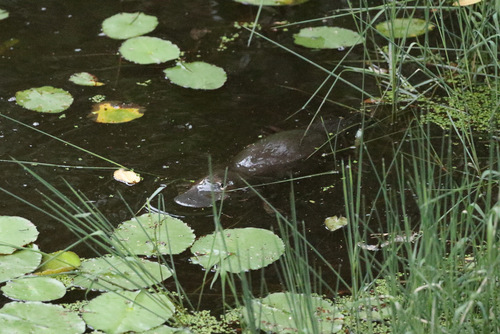
When the first specimens arrived in Europe, some naturalists thought it was a taxidermic hoax: an animal with a duck's bill, a beaver's tail, webbed feet, and which also lays eggs.
The Platypus is one of the few oviparous mammals. The male is also one of the few venomous mammals, with a spur on its hind feet capable of causing intense and lasting pain.
It lives exclusively in the rivers of eastern Australia, where it hunts with its eyes closed, detecting its prey by the tiny electrical impulses they generate when moving.
A unique semi-aquatic mammal, the Platypus has a flattened body covered in dense, dark brown, waterproof fur; a soft, sensitive, duck-bill-shaped snout; webbed feet with a venomous spur on the male; and a broad, flat tail like a Beaver's but much smaller. Unmistakable: it is the only mammal with a horny
Webbed track with 5-toe marks, 4-6 cm long, visible in the mud on banks; the webs retract when walking on land, also leaving claw marks. Droppings are indistinctive and rarely found; the most reliable sign is burrows dug into banks, with the entrance just above or below water level, and wakes and bubbles on the surface when swimming at night.
Rivers, streams and freshwater lakes with soft earth banks for digging burrows, from lowlands to mountain areas. Endemic to eastern Australia, including Tasmania.
Carnivore: It feeds on aquatic invertebrates (larvae, shrimps, worms) which it locates underwater with its eyes closed using electroreception in its bill.
Solitary and semi-aquatic, the Platypus digs burrows in banks where it rests by day. The male has a venomous spur on its hind feet, used in territorial disputes during the breeding season. The female lays 1-3 eggs, which she incubates in the burrow.
Populations have declined and become locally extinct in parts of its historical range in recent decades, with documented reductions particularly in drought-affected catchments and those with regulated flows; more stable populations persist in Tasmania.
Prolonged droughts, water extraction reducing river flow, riverbank degradation, bycatch in creels and fishing nets, and predation by introduced species.
Full index of mammal species accounts
Mammaling is a free app for logging the mammals you find. You record a sighting in a moment — even if it's just a track — your life list grows, and the record becomes available to scientific and conservation projects.
It runs on your phone with nothing to install. If you like, it adds to your home screen like any other app.
Open Mammaling