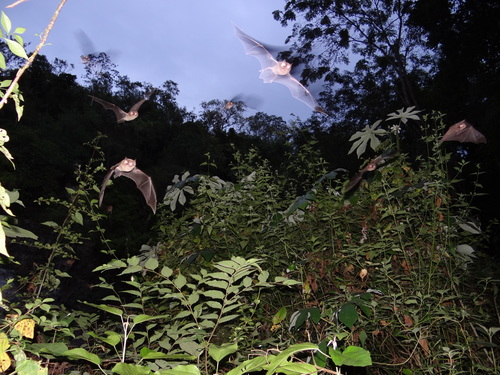
Until recent years, this bat was considered part of a single, widespread species, Pteronotus parnellii, ranging from Mexico to South America. Recent genetic and morphological studies split this broad concept into several independent Mesoamerican species, of which the Mesoamerican Common Mustached Bat is one of the most common. Despite the name change, its underlying biology remains the same one that made the group famous among chiropterologists: it uses a high-precision echolocation system with Doppler-shift compensation, allowing it to distinguish the flutter of a moth's wings from background vegetation clutter.
A medium-sized mormoopid with a forearm of 55-63 mm (Yucatán Peninsula populations are noticeably smaller than those in Costa Rica and Panama) and a weight of 16-19,5 g. The fur is reddish-brown to greyish-brown, and the face shows the upturned snout characteristic of the genus. In the hand, it is virtually indistinguishable from P. mexicanus, its sister species, and from other species of the former P. parnellii complex. Reliable separation requires fine genetic or morphometric data (such as details of the skull's sella turcica) that are unavailable during field identification.
It uses high duty-cycle echolocation with Doppler-shift compensation typical of the former P. parnellii complex: a constant-frequency reference component around 61 kHz in the second harmonic, flanked by short frequency-modulated sweeps. Functionally, this system is equivalent to that of Old World rhinolophids. As this reference frequency is shared by P. mexicanus and P. parnellii sensu stricto, the sonogram alone cannot reliably separate these species. A reading of "CF around 61 kHz with Doppler compensation" identifies only the complex, not the exact species, and must be recorded as such. Tracks and signs at the roost consist of abundant accumulations of guano beneath perches in warm caves and mines, often shared with other mormoopids.
Continuous or fragmented forests and dense, high-canopy riparian vegetation, as well as adjacent agricultural areas. It uses caves and mines as roosts and forages along nearby forest edges. Distributed from Mexico (Gulf slope, Isthmus of Tehuantepec and the Yucatán Peninsula) to the Panama Canal zone.
Insectivorous; feeds mainly on beetles, alongside moths, flies, orthopterans and hymenopterans.
Prefers warm caves for its colonies, particularly as nursery roosts, though it tolerates slightly lower roost temperatures (below 20 °C) at the northern edge of its range, showing less strict thermal requirements than smaller mormoopids.
Considered a common species with generalist habitat requirements within its range, although as a recently recognised taxon it does not yet have its own independent IUCN assessment.
Closure and disturbance of caves and mines used as roosts, alongside the loss of high-canopy and riparian forest in foraging areas.
See all species accounts for bats · Full species index
Mammaling is a free app for logging the mammals you find. You record a sighting in a moment — even if it's just a track — your life list grows, and the record becomes available to scientific and conservation projects.
It runs on your phone with nothing to install. If you like, it adds to your home screen like any other app.
Open Mammaling