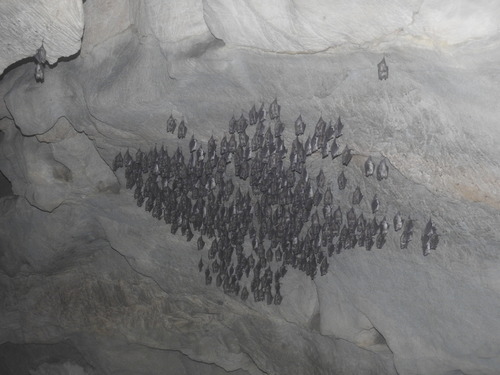
The Mediterranean Horseshoe Bat hangs from the cave ceiling, completely wrapped in its own wings, like a dry leaf hanging upside down. This makes it easy to recognise among cave bats even without seeing its face.
It emits a very distinct type of call from most European bats: instead of a variable chirp, it maintains a pure and sustained note, which it adjusts in real time to compensate for its own movement.
The Mediterranean Horseshoe Bat is a small-medium sized bat with greyish-brown to reddish fur. It has a complex horseshoe-shaped noseleaf that it uses to direct its echolocation pulse, a trait shared by the entire genus. It can be confused with other European horseshoe bats, especially the Mehely's Horseshoe Bat (R. mehelyi), which has very similar size and call frequency. Reliable separation in the hand is based on details of the noseleaf and forearm size.
Constant frequency of approximately 102 to 108 kHz, with Doppler compensation: the Mediterranean Horseshoe Bat adjusts the emitted frequency in flight so that the returning echo always maintains the same reference note. CF-type pulse with brief FM segments at the beginning and end, which appears on the detector as a very pure and stable horizontal bar, distinct from the sweep of Myotis. Long duration, 20 to 50 milliseconds, with regular intervals characteristic of hunting flight in enclosed spaces.
It can be acoustically confused with Rhinolophus mehelyi, whose constant frequency partially overlaps with that of
Warm caves and mines are used for shelter. Foraging occurs in Mediterranean forest, scrub, and nearby areas of dense vegetation, from lowlands to mid-mountain areas.
Distributed throughout the Mediterranean basin, from the Iberian Peninsula to the Near East, with fragmented and generally scarce populations.
Insectivorous, the Mediterranean Horseshoe Bat hunts mainly moths and other slow-flying insects near vegetation, often by ambush hunting from a perch.
The Mediterranean Horseshoe Bat forms breeding colonies, often mixed with other horseshoe bats, in warm caves. It shows strong fidelity to the same roost. It is very sensitive to human disturbance during breeding and hibernation, a period when it forms dense clusters hanging from the ceiling.
Its populations have suffered a notable decline in much of Europe due to the loss and alteration of breeding caves, although some protected Mediterranean colonies remain relatively stable.
Disturbance and closure of caves used as roosts, disturbance at breeding and hibernation colonies, loss of Mediterranean forest and scrub foraging habitat, and use of insecticides in nearby agricultural areas.
See all species accounts for bats · Full species index
Mammaling is a free app for logging the mammals you find. You record a sighting in a moment — even if it's just a track — your life list grows, and the record becomes available to scientific and conservation projects.
It runs on your phone with nothing to install. If you like, it adds to your home screen like any other app.
Open Mammaling