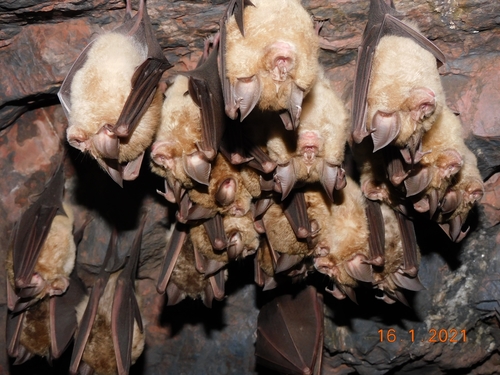
The Greater Horseshoe Bat is the largest of Europe's horseshoe bats. It is also one of the few rhinolophids that can be reliably identified from its relatives by sound alone, as its echolocation frequency is notably lower than that of almost all other members of the genus on the continent. It hangs from the cave ceiling completely wrapped in its own wings, resembling a withered leaf hanging upside down. It emits an echolocation pulse so pure and sustained that it adjusts the emitted frequency in real time to compensate for its own motion. This is an acoustic feat unique to rhinolophids. Its populations suffered a sharp decline in much of Western Europe during the 20th century. Where recovery has occurred, it is one of the most frequently cited bat conservation success stories on the continent.
The Greater Horseshoe Bat is a large bat for a rhinolophid, one of the largest in Europe, with greyish-brown to reddish fur and a complex horseshoe-shaped noseleaf it uses to direct its echolocation pulse. It differs from other European rhinolophids, which are notably smaller, by its much larger size. Only the Mediterranean Horseshoe Bat approaches it in size, though it occupies a smaller area.
Constant frequency of approximately 77 to 83 kHz, with Doppler compensation: the Greater Horseshoe Bat adjusts the emitted frequency in flight so the returning echo always remains at the same reference note. CF-type pulse with brief FM segments at the beginning and end, visible on the detector as a very pure and stable horizontal bar, the lowest-pitched among common European horseshoe bats. Long duration, 20 to 50 milliseconds. Unlike most pairs of European horseshoe bats, this species is quite reliably separable from others by sonogram, thanks to its notably lower frequency than that of its smaller relatives. Under cave roosts, guano accumulates in very characteristic conical piles, often with discarded remains of large beetles and moths around them. It emerges relatively late after sunset, with a low, unhurried flight near vegetation.
Warm caves and mines for roosting, with foraging in nearby open woodland, scrub, and wooded pasture, from lowlands to mid-mountain areas. Distributed across southern and central Europe, North Africa, and much of Asia as far as Japan.
Insectivorous, it hunts mainly large beetles and moths by means of ambush hunting flight from a perch, alternated with active low-level flight.
The Greater Horseshoe Bat forms breeding colonies in warm caves, showing strong fidelity to the same roost year after year. It is notably sensitive to human disturbance during breeding and hibernation. Its distribution and abundance are considered good indicators of the quality of the traditional agroforestry landscape in its surroundings.
Greater Horseshoe Bat populations have recovered remarkably in several areas of Western Europe. This is thanks to the legal protection of breeding caves and the conservation of traditional agroforestry landscapes, following a very marked decline throughout much of the 20th century.
Disturbance in breeding and hibernation caves. Loss of traditional agroforestry landscapes with hedges and wooded pasture, on which the Greater Horseshoe Bat relies for hunting. And insecticide use, which reduces the availability of large beetles.
See all species accounts for bats · Full species index
Mammaling is a free app for logging the mammals you find. You record a sighting in a moment — even if it's just a track — your life list grows, and the record becomes available to scientific and conservation projects.
It runs on your phone with nothing to install. If you like, it adds to your home screen like any other app.
Open Mammaling