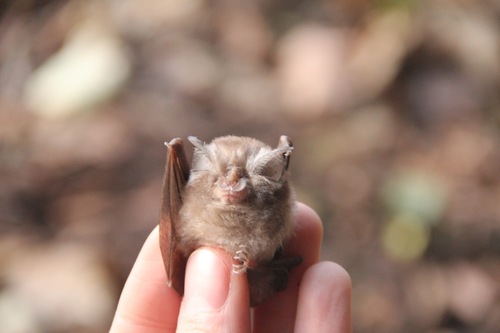
The Lesser Horseshoe Bat is the smallest of Europe's horseshoe bats, so tiny it can fit almost entirely in the palm of a hand. It is also one of the easiest rhinolophids to distinguish from its relatives by sound, thanks to an echolocation frequency notably higher-pitched than that of any other common rhinolophid on the continent. It hangs from the ceiling completely wrapped in its own wings, a characteristic shared with the rest of the genus. Like them, it emits a constant frequency pulse, which it adjusts in real time to compensate for its own movement in flight. Its populations suffered one of the most severe contractions of any European bat during the 20th century, disappearing completely from large areas in the north of its range. The exact causes of this decline are still debated.
The Lesser Horseshoe Bat is a tiny bat, the smallest of the European horseshoe bats. It has greyish-brown fur and a horseshoe-shaped noseleaf characteristic of the genus, which is proportionally smaller than in its larger relatives. It differs from other European horseshoe bats, which are notably larger, by its much reduced size, almost half that of the Greater Horseshoe Bat.
Constant frequency of approximately 108 to 114 kHz, with Doppler compensation. CF-type pulse with brief FM segments at the beginning and end, visible on the detector as a very pure and stable horizontal bar, the sharpest among common European horseshoe bats. Duration 20 to 40 milliseconds, somewhat shorter than that of its larger relatives. Like the Greater Horseshoe Bat,
Roosts in caves, cellars, attics, and small mines. Forages in woodland edge, hedgerows, and dense nearby vegetation, from lowlands to mid-mountain areas.
Fragmented distribution across southern, western, and central Europe, North Africa, and parts of Western Asia.
Insectivorous, it hunts small flying insects and spiders close to dense vegetation, with a slow flight very near the foliage.
The Lesser Horseshoe Bat forms small to medium-sized breeding colonies in attics, cellars, and small caves, showing strong fidelity to the same roost. It is very sensitive to human disturbance and to the loss of landscape connectivity, as it avoids crossing open spaces without vegetation cover.
Its populations suffered a very severe decline across much of northern Europe during the 20th century, with confirmed local extinctions in several countries, although in some areas of the south and west of the continent it remains relatively widespread and shows signs of some recent recovery.
Loss of landscape connectivity from the removal of hedges and edge vegetation, which the Lesser Horseshoe Bat uses as flight corridors; disturbance in breeding and hibernation roosts; and the use of insecticides, which reduces prey availability.
See all species accounts for bats · Full species index
Mammaling is a free app for logging the mammals you find. You record a sighting in a moment — even if it's just a track — your life list grows, and the record becomes available to scientific and conservation projects.
It runs on your phone with nothing to install. If you like, it adds to your home screen like any other app.
Open Mammaling