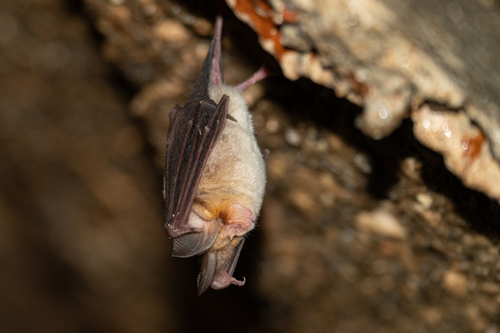
Mehely's Horseshoe Bat is one of the rarest horseshoe bats in Europe, and also one of the most demanding regarding the temperature of its breeding caves. So much so that the availability of suitable roosts alone dictates where the species can or cannot live across much of its range. Like other horseshoe bats, it emits an echolocation pulse so sustained and pure that it sounds almost like a continuous whistle, very different from the variable chirping of most European bats. Its name honours the Hungarian zoologist who first described it in the early 20th century, when it was still thought that there were few differences between Mediterranean horseshoe bats.
Mehely's Horseshoe Bat is a small to medium-sized bat with greyish-brown fur and the genus's characteristic horseshoe-shaped noseleaf. It is very similar to the Mediterranean Horseshoe Bat (Rhinolophus euryale).
It is most often confused with the Mediterranean Horseshoe Bat, from which it differs by a slightly higher call frequency and fine details of the noseleaf. In practice, both species usually require capture or roost inspection for reliable identification.
Constant frequency of approximately 106-112 kHz, with Doppler compensation that keeps the returning echo stable during flight. CF-type pulse with brief FM sections at the start and end, visible on the detector as a pure, very stable horizontal bar, somewhat higher-pitched than that of Rhinolophus euryale. Long duration, 20-50 milliseconds, with regular intervals during hunting flight. Acoustically, Mehely's Horseshoe Bat can be confused with Rhinolophus euryale, with which its frequency range partly overlaps. In that overlap zone, the species cannot be confirmed by sonogram alone; identification should be supported by locating the roost or by capture. Under cave roosts, very compact conical piles of guano accumulate, with insect wing remains around them. Mehely'
Shelters in warm caves and mines, hunting in open Mediterranean scrub and nearby areas of low vegetation, almost always in lowlands and at low altitude.
Its distribution is highly fragmented across southern Europe, North Africa, and Southwest Asia.
Insectivorous, Mehely's Horseshoe Bat hunts moths and other slow-flying insects near the ground and low vegetation, with a slow and very manoeuvrable hunting flight.
Mehely's Horseshoe Bat forms breeding colonies, often mixed with other rhinolophids, in caves with a very specific temperature. Reproduction is strictly dependent on this microclimate. It is very sensitive to disturbance in its breeding and hibernation roosts.
Its populations are considered to be in decline across much of its range due to the scarcity of caves with suitable microclimates and the loss of Mediterranean scrub for hunting. Some known colonies are among the smallest of all European Horseshoe Bats.
Alteration and loss of caves with the warm microclimate necessary for breeding, human disturbance in breeding and hibernation colonies, and loss of open Mediterranean scrub due to changes in land use.
See all species accounts for bats · Full species index
Mammaling is a free app for logging the mammals you find. You record a sighting in a moment — even if it's just a track — your life list grows, and the record becomes available to scientific and conservation projects.
It runs on your phone with nothing to install. If you like, it adds to your home screen like any other app.
Open Mammaling