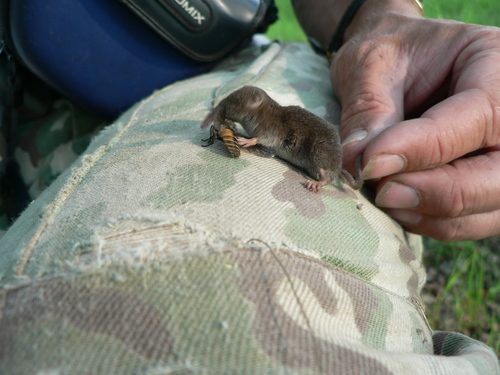
Weighing less than a coin, and with a heart that beats several hundred times per minute, the Eurasian Pygmy Shrew lives at its metabolic limit. It is forced to eat almost constantly to avoid starving in a few hours. It is one of Europe's smallest terrestrial mammals, so tiny that it is often confused with a newborn mouse young. It spends almost its entire life hidden among leaf litter and dense vegetation, out of sight. Its life cycle is as accelerated as its metabolism: it rarely exceeds one and a half years of age.
The Eurasian Pygmy Shrew is a very small shrew with a long, pointed snout, uniform grey-brown fur, tiny, barely visible eyes, and teeth with dark red tips due to iron deposits. It differs from mice by its elongated, mobile snout and by lacking the large ears and bulging eyes typical of rodents. It is most often confused with the Common Shrew, which is larger and has a proportionally shorter tail.
Tiny track, barely 1-1.5 cm, with 5 toes, almost never visible except in very fine mud or fresh snow. Tiny, dark droppings, 3-5 mm long, with shiny insect chitin remains, left scattered along its routes under vegetation. Its presence is best revealed by a sharp, repeated squeak, almost a click, which it emits when defending its territory from other shrews. Small surface runways among the leaf litter and at the base of vegetation also indicate its presence.
Meadow, heathland, hedgerow, woodland with dense undergrowth and scrubland, from lowlands to mid-mountain areas.
Distributed across much of Europe and northern Asia, as far as eastern Siberia.
Strictly insectivorous: it hunts insects, spiders, earthworms and other small invertebrates, located primarily by smell and the touch of its whiskers. It needs to eat several times its own weight in food every day to maintain its accelerated metabolism.
Solitary and highly territorial, the Eurasian Pygmy Shrew actively avoids contact with other shrews except during oestrus. It does not hibernate, remaining active all year round and alternating short periods of activity and rest throughout the day and night. Its lifespan is very short, barely 12-18 months, with a single reproductive season before death.
The Eurasian Pygmy Shrew maintains large and stable populations in most of its Eurasian range, without signs of widespread decline.
Loss of hedges and habitat with dense vegetative cover due to agricultural intensification, and pesticide use reducing its insect prey, without significant global threats.

Photographs by Mammaling users, published under a Creative Commons Attribution-NonCommercial licence.
See all species accounts for hedgehogs and shrews · Full species index
Mammaling is a free app for logging the mammals you find. You record a sighting in a moment — even if it's just a track — your life list grows, and the record becomes available to scientific and conservation projects.
It runs on your phone with nothing to install. If you like, it adds to your home screen like any other app.
Open Mammaling