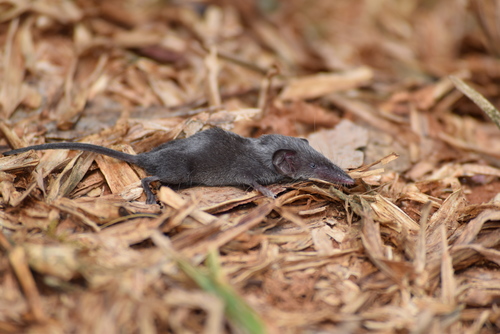
The smallest terrestrial mammal in the world by weight, an adult Etruscan Shrew can weigh less than a small coin. Its heart beats at such a rapid rate that it approaches the known physiological limits for a mammal. To maintain this extreme metabolism, it must eat several times its own weight in insects daily. It can die of starvation in just a few hours without food, a survival margin far narrower than that of almost any other mammal on the planet. Despite its tiny mouse-like appearance, the Etruscan Shrew has no close relation to rodents. Instead, it belongs to the shrew group, which is much more closely related to moles.
The Etruscan Shrew is a tiny mammal, the smallest in the world by weight. Its body is barely the size of a thumb, with greyish-brown fur, an extremely elongated and mobile snout, and white teeth lacking the reddish tips found in shrews of the genus Sorex. It differs from any other small mammal in its habitat simply by its extreme size, being notably smaller than any mouse or shrew with which it might be confused at first glance.
Tiny track, barely 0.7-1 cm long, practically impossible to find in the field except in exceptional circumstances of very fine substrate. Tiny droppings, 1-2 mm long, with insect chitin remains visible only under a magnifying glass, left scattered along its surface runways under dense vegetation or between cracks in stone walls. It builds small grass nests in hollows under stones or in wall cracks. Its presence is mainly revealed by a sharp, rapid, almost imperceptible squeak, rather than by any visible physical tracks and signs given its extreme size.
Areas of dense vegetation, Mediterranean scrub, traditional stone walls, and abandoned cultivated areas, from sea level to mid-mountain zones.
Found across southern Europe, North Africa, and parts of Asia as far as Southeast Asia, a very wide range for such a small mammal.
Insectivorous, it feeds on small insects and other invertebrates. Its extremely accelerated metabolism necessitates it to eat almost constantly throughout the day and night.
Active continuously throughout the day and night in very short bursts due to its extreme metabolism. Its behaviour is generally solitary and territorial. It can only survive a few hours without food, one of the shortest known among mammals.
Populations are generally stable throughout its wide range, with no documented evidence of widespread decline, thanks in part to its tolerance of a relatively wide variety of Mediterranean habitats.
Loss of scrub vegetation and traditional stone walls in the agricultural landscape, and pesticide use which reduces the availability of small invertebrate prey.
See all species accounts for hedgehogs and shrews · Full species index
Mammaling is a free app for logging the mammals you find. You record a sighting in a moment — even if it's just a track — your life list grows, and the record becomes available to scientific and conservation projects.
It runs on your phone with nothing to install. If you like, it adds to your home screen like any other app.
Open Mammaling