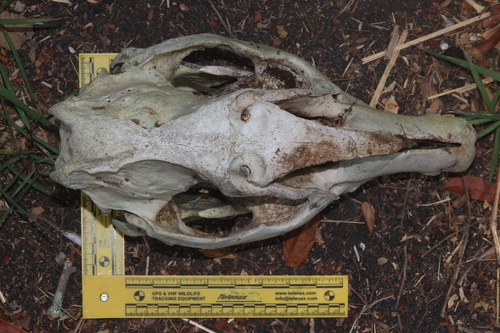
The Central American Tapir is the largest terrestrial mammal in Central America, a true forest gardener. It disperses the seeds of hundreds of tree species. Its digestive tract is so slow that it can take days to excrete them, carrying them much further from the parent tree than seeds spread by wind or small animals. It has a small prehensile proboscis, which is actually an extension of its upper lip and nose. It uses this to pluck leaves and twigs with surprising precision for such a bulky animal. An evolutionary survivor, it has remained almost unchanged for millions of years. It is more closely related to horses and rhinoceroses than to any other mammal in the forest where it lives.
A large, bulky mammal with a stocky body covered in short, dark brown to blackish fur, a pale band around the eyes, white-edged ears, and a small, prehensile proboscis. The young, with pale stripes and spots on a dark background, are easily distinguished from uniformly coloured adults. It cannot be confused with any other wild mammal in its area due to its size and characteristic proboscis.
Tracks show 3 visible fore toes and a fourth vestigial one that sometimes marks in soft substrate, and 3 hind toes. They are almost round in shape, 8-12 cm long, and much larger than those of a Peccary or a Deer with which the Central American Tapir shares habitat.
Voluminous, fibrous droppings are often deposited in puddles or directly in water. This characteristic behaviour makes them difficult to find on land.
The Central American Tapir leaves very marked and repeated runs between feeding areas and mud wallows. It also leaves bite marks on low branches, browsed at a characteristic height. Large mud wallows are found near water, where the animal cools down and rids itself of parasites.
Humid tropical forest, gallery forest and wetland. Strongly dependent on water, from lowlands up to about 3600 m in some mountainous areas.
Very fragmented distribution across Central America, from southern Mexico to north-western Colombia and Ecuador.
A browsing herbivore and frugivore, it feeds on leaves, shoots, fallen fruit, and aquatic plants, torn off with the help of its small prehensile proboscis.
Solitary and primarily nocturnal and crepuscular, the Central American Tapir has a large home range centred on permanent water sources, which it uses daily to bathe and cool itself. The female raises a single young approximately every 2 years, one of the slowest reproductive rates among large American herbivorous mammals.
The Central American Tapir has already disappeared from much of its historical distribution range in Central America. Reduced and fragmented populations persist mainly in large blocks of protected forest. Outside these areas, the general trend continues to be one of decline.
Loss and fragmentation of tropical forest due to agricultural and livestock expansion, hunting for meat consumption, roadkill on roads that cross its habitat, and its very low reproductive rate, which makes any population recovery very slow.
See all species accounts for odd-toed ungulates · Full species index
Mammaling is a free app for logging the mammals you find. You record a sighting in a moment — even if it's just a track — your life list grows, and the record becomes available to scientific and conservation projects.
It runs on your phone with nothing to install. If you like, it adds to your home screen like any other app.
Open Mammaling