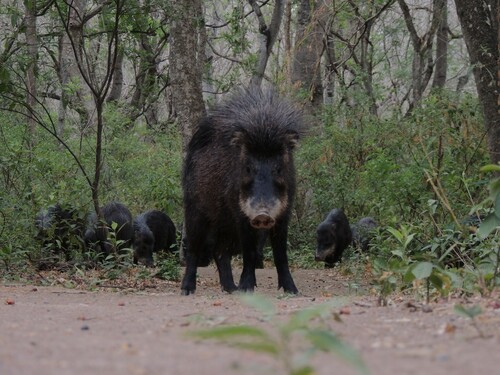
The White-lipped Peccary lives and moves in herds of up to several hundred individuals, an exceptional group size among large American tropical terrestrial mammals. They range over extensive areas of jungle, emitting a characteristic teeth-chattering sound and a strong musky odour that betrays their presence long before they are seen. It is the largest of the American peccaries, a group of wild pig-like mammals that evolved independently in the Americas, with no direct relation to Old World pigs. Their gregarious behaviour and tendency to defend themselves as a group against a predator, including the Jaguar, make them risky prey even for large American felines. Their populations have suffered sudden and very localised collapses in some areas of Mesoamerica. This pattern of sudden disappearance is not yet fully explained, but it has raised alarms among conservation specialists in the region.
The White-lipped Peccary is the largest of the American peccaries. It has dark, almost black fur, a robust body, and relatively short legs. Its name comes from the whitish jaw and snout area. It differs from the Collared Peccary, which is smaller and has a pale band around its neck rather than on its jaw. The White-lipped Peccary is distinguished by its larger size, darker colouring, and much larger herds.
Cloven track with two hooves, 4-5 cm long, slightly larger and more rounded than that of the Collared Peccary. Droppings are irregular, clustered pellets, 2-3 cm long, left scattered in wallowing and feeding areas. It leaves very visible mud wallows and tusk marks on tree trunks where it rubs to scent-mark its territory. The tracks and signs of trampled and rooted vegetation are much more extensive than those of a Collared Peccary, reflecting the large size of White-lipped Peccary herds. A strong, persistent musky odour also lingers in passage areas.
Lowland humid tropical forest, preferring areas with water bodies and mud wallows.
Fragmented distribution from southern Mexico to northern Argentina, across Central America and much of tropical South America.
Omnivorous, it feeds mainly on fallen fruit, seeds, roots, and occasionally small vertebrates or invertebrates, foraging in herds while rooting the ground with its snout.
White-lipped Peccaries live in very large herds of tens to several hundred individuals, roaming large areas of jungle in search of food. They communicate through teeth chattering and vocalizations. The herd defends its members against predators, a collective behaviour unusual among large tropical terrestrial mammals.
Its populations have suffered sudden local collapses in several areas of Mesoamerica, with documented local extinctions in areas where it was formerly abundant. In other regions of its South American distribution, it remains relatively stable.
Subsistence and commercial hunting, deforestation and fragmentation of tropical rainforest due to agricultural and livestock expansion, and potential disease outbreaks that could explain some of the sudden population collapses observed in Mesoamerica.
See all species accounts for even-toed ungulates · Full species index
Mammaling is a free app for logging the mammals you find. You record a sighting in a moment — even if it's just a track — your life list grows, and the record becomes available to scientific and conservation projects.
It runs on your phone with nothing to install. If you like, it adds to your home screen like any other app.
Open Mammaling