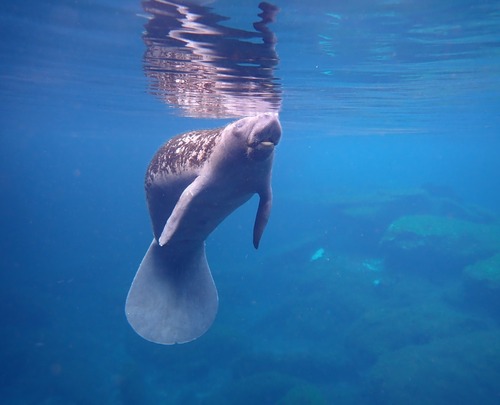
Despite its enormous size, the West Indian Manatee is a completely harmless animal, moving with extreme calm. So much so that in Florida it is common to find it sharing canals with recreational boats. This coexistence, however, proves to be its greatest threat.
It is a close relative of the Dugong but lives in a much more varied habitat. It can move between salt, brackish, and completely fresh water, even ascending rivers hundreds of kilometres inland in search of warm waters in winter.
Its closest evolutionary kinship, surprisingly, is not with other marine mammals but with Elephants. They share a common terrestrial ancestor from tens of millions of years ago.
A large sirenian with a bulky, rounded, brownish-grey body, often with algae adhering to its skin. It has a wide snout with a divided and very mobile upper lip. Its rounded, paddle-shaped tail is distinct from the dugong's bilobed, crescent-shaped tail.
It differs from the dugong, a species with which it does not geographically overlap in its main range, by its rounded tail and less downward-pointing snout.
It leaves no terrestrial tracks. The most characteristic tracks and signs are circular, smooth areas on the water's surface, known as manatee tracks and signs. These are produced by the upward movement of the tail when the West Indian Manatee swims near the surface, and are visible even without seeing the animal. It also leaves feeding trails in aquatic grass meadows, similar to those of the Dugong but
Rivers, estuaries, coastal bays and warm shallow marine waters, with the ability to move freely between fresh and salt water. Distributed throughout the Caribbean, the Gulf of Mexico and the Atlantic coast of North and South America, from the southeastern United States to northeastern Brazil, with winter concentrations in waters warmed by springs or industrial discharges in some areas.
Herbivorous, it feeds on a wide variety of submerged, floating, and riparian aquatic plants. It tears these off with its divided and very mobile upper lip, and can consume large quantities of vegetation daily.
Generally solitary or in small, temporary groups, with a greater tendency to aggregate in warm water areas during winter. The female raises a single young every 2-5 years, with a very strong mother-young bond during the first year of life.
Its populations have recovered notably in some areas, such as Florida, thanks to decades of legal protection and the creation of warm-water sanctuaries. In much of the rest of its range, however, especially in Central America and northern South America, the West Indian Manatee remains in decline due to hunting and habitat loss.
Collision with boats, especially in areas of dense boat traffic, entanglement in fishing gear, loss of warm-water habitat and seagrass beds, and local poaching in some parts of its range.
Full index of mammal species accounts
Mammaling is a free app for logging the mammals you find. You record a sighting in a moment — even if it's just a track — your life list grows, and the record becomes available to scientific and conservation projects.
It runs on your phone with nothing to install. If you like, it adds to your home screen like any other app.
Open Mammaling