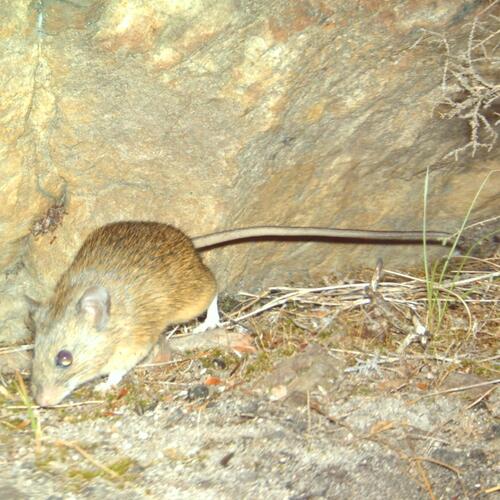
It lives only in fynbos, the scrub vegetation of south-western South Africa, found nowhere else in the world. There it plays an ecological role that almost nobody associates with a rodent: it disperses and stores the seeds of several plants in the legume family, and is regarded as an occasional pollinator of at least one plant species, feeding on its nectar and carrying pollen between flowers. Like the other spiny mice, it can shed skin from its back if a predator seizes it, and its scaly, almost naked tail breaks off just as easily if it is caught by that.
Small rodent with dark greyish-brown fur on the back and stiff spiny hairs, and a white belly. The eyes and ears are large in proportion to the body, and the tail is long, scaly and fragile. It differs from other spiny mice of southern Africa in its range, which is restricted almost entirely to the Western Cape province.
Tiny track, hard to find except on fine substrates. Droppings are small and elongated, 3-4 mm long. The clearest sign is usually the refuge, in crevices between mountain rocks or under dense fynbos scrub, together with partly eaten or stored legume seeds near the entrance.
Mountain and lowland fynbos in the Western Cape province (South Africa), extending marginally into the Eastern Cape and Northern Cape.
Seeds, mainly of fynbos legumes, insects, nectar from some flowers, and other small invertebrates.
Its habits are poorly known because the species is so elusive. Breeding is thought to be opportunistic, tied to food availability after fire, a key factor in fynbos dynamics.
The species maintains a large, stable population within the fynbos, a habitat that for the most part occupies rocky land unsuited to agricultural transformation, which protects it from most of the threats affecting other species in the region.
Localised habitat loss to urban and agricultural expansion in the lowlands of the fynbos, and disruption of the natural fire regime.
See all species accounts for rodents · Full species index
Mammaling is a free app for logging the mammals you find. You record a sighting in a moment — even if it's just a track — your life list grows, and the record becomes available to scientific and conservation projects.
It runs on your phone with nothing to install. If you like, it adds to your home screen like any other app.
Open Mammaling