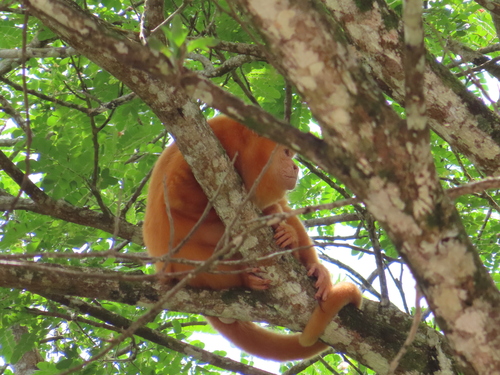
Its roar can be heard over three kilometres away through the dense tropical forest, one of the most powerful sounds any terrestrial mammal can produce relative to its size, generated by a specialised resonating chamber in the throat. It lives in troops that spend much of the day resting in the treetops, calmly digesting a diet of leaves that demands much more lethargy than energy. The Mantled Howler's name comes from the long, golden fur that falls down its sides like a cape, especially striking in adult males of some populations.
The Mantled Howler is a medium-large primate with a robust body, black fur with a golden or straw-coloured lateral mantle, more or less marked depending on the population. Its long, prehensile tail is hairless on the underside of the tip and used as a fifth limb. It differs from other Spider Monkeys and Capuchins that share its habitat by its much more robust body, thick, muscular tail, and especially by its characteristic roar, which is unmistakable among American primates.
Hand and foot tracks, 6-9 cm long, with 5 humanoid-looking digits and a well-developed opposable thumb on both fore and hind limbs. Irregular, soft droppings, with abundant, poorly digested plant fibre, left scattered under trees where the Mantled Howler feeds or rests. The Mantled Howler's presence is mainly revealed by its deep, prolonged roar. This is audible at dawn and dusk, and used to mark territory between neighbouring troops without physical contact. Other signs include shaken branches and fallen leaves under feeding trees.
Humid and semi-deciduous tropical forest, gallery forest and mangrove, from lowlands up to about 2000 m in altitude. Distributed throughout Central America and northwestern South America, from southern Mexico to Ecuador and northern Colombia and Venezuela. Populations and subspecies have conservation statuses that vary greatly by region.
Primarily folivorous, it feeds on young leaves, supplemented with fruit, flowers, and shoots according to seasonal availability. Its diet requires long periods of rest to digest plant fibre.
Mantled Howlers live in groups of several males and females, with relatively loose dominance hierarchies. They defend their territory by roaring, rather than engaging in direct physical confrontations with neighbouring troops. Mantled Howlers spend much of the day inactive, resting and digesting, with activity peaking at dawn and dusk.
The situation varies greatly depending on the subspecies and region. Northern populations in its range, in southern Mexico, have suffered a severe decline due to forest loss. However, other populations further south remain relatively stable, placing the Mantled Howler as a whole in an intermediate threat category.
Loss and fragmentation of tropical forest due to agricultural and livestock expansion, electrocution on power lines when moving between forest fragments, local hunting, and capture for the pet trade in some areas.
See all species accounts for primates · Full species index
Mammaling is a free app for logging the mammals you find. You record a sighting in a moment — even if it's just a track — your life list grows, and the record becomes available to scientific and conservation projects.
It runs on your phone with nothing to install. If you like, it adds to your home screen like any other app.
Open Mammaling