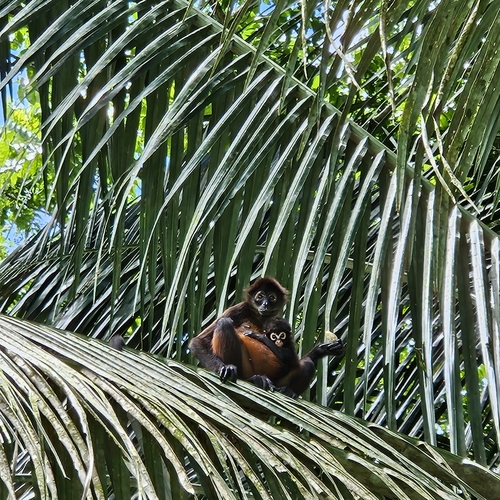
Its tail is so agile that it can be used almost like a fifth hand. It can support its entire weight while hanging from a branch, leaving all four limbs free to reach for fruit. Few primates can match this mastery of arboreal life.
It moves through the treetops with a very characteristic brachiation style, swinging from branch to branch. This agile yet ungainly appearance gives the Central American Spider Monkey its common name.
The Central American Spider Monkey is one of the most threatened primates in Central America. It is very sensitive to forest fragmentation, needing large, continuous areas of mature rainforest to find enough fruit throughout the year.
A medium-large primate with a slender body and limbs very long in proportion to its trunk. Its fur varies from reddish-brown to black depending on the subspecies. It has a naked face, pink or black. Its very long prehensile tail is longer than its body, with the inner surface of the tip hairless.
It lacks a functional thumb on its hand. This trait differentiates it from other American primates and is paradoxically useful for moving in flight between branches.
Hand track without a functional thumb, with 4 long, curved digits, 8-11 cm long, and foot track with 5 digits, the first opposable. Irregular droppings with abundant whole, poorly digested seeds, a very visible feature given its role as a disperser of large fruit seeds. Its presence is indicated by branches vigorously shaken as it moves, half-eaten fruit fallen beneath trees, and a guttural alarm bark emitted when detecting a threat, very distinct from the Howler Monkey's roar.
Mature humid and semi-deciduous tropical forest, preferring large continuous areas of forest, from lowlands up to about 2500 m altitude. Distributed throughout Central America and southern Mexico, with a small part of its range reaching north-western Colombia.
Mainly frugivorous, the Central American Spider Monkey prefers ripe fruit, supplemented with young leaves, flowers, and seeds. Its role as a seed disperser for large-fruited trees is key to tropical forest regeneration.
It lives in large communities that divide into small, changing subgroups. These subgroups gather and separate throughout the day depending on fruit availability, a social system known as fission-fusion. The female raises a single young every 3-4 years, one of the longest reproductive intervals among American primates.
The Central American Spider Monkey has suffered a marked decline in much of its range due to the loss and fragmentation of tropical forest. Some subspecies and peripheral populations, such as those in southern Mexico, are in a much more critical conservation situation than the species average.
Loss and fragmentation of tropical forest from agricultural and livestock expansion, hunting for local consumption, and capture of young for the pet trade. These factors, combined with the Central American Spider Monkey's low reproductive rate, hinder the recovery of decimated populations.
See all species accounts for primates · Full species index
Mammaling is a free app for logging the mammals you find. You record a sighting in a moment — even if it's just a track — your life list grows, and the record becomes available to scientific and conservation projects.
It runs on your phone with nothing to install. If you like, it adds to your home screen like any other app.
Open Mammaling