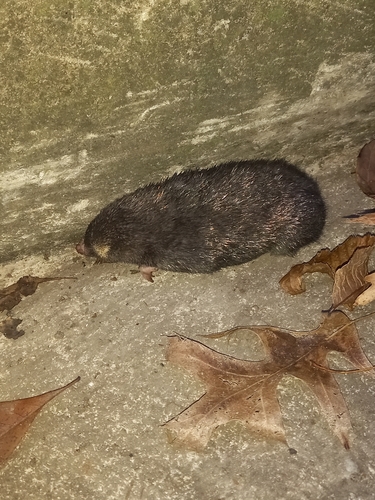
A blind, subterranean insectivore endemic to the fynbos-covered mountains and coastal plains around Cape Town. It belongs to a group of golden moles so ancient, and so physiologically distinct from true moles, that it represents a separate evolutionary experiment in life underground. It is almost never seen, and its presence is betrayed only by the ridges of raised earth it leaves when burrowing just beneath the surface after rain.
Small cylindrical body with no visible tail or external ears, eyes covered by skin, and dense fur with a metallic sheen, ranging from blackish grey to reddish brown depending on the population. It differs from the Cape Golden Mole mainly in its more restricted distribution, tied to the fynbos of the southern Cape mountains and the coastal plain. From other Amblysomus species it is separated mainly by range, since golden moles are very hard to tell apart by external appearance.
Raised, winding ridges at the surface above shallow foraging tunnels, especially visible in soft soil or lawns after rain. It leaves no tracks, being a wholly subterranean animal. Small mounds of loose earth occasionally mark the entrance to deeper, permanent burrows.
Fynbos scrub, adjacent forest edges and coastal-plain vegetation of the southern Cape mountains, in South Africa. It tolerates gardens and disturbed soil within that range.
Insectivorous, feeding on earthworms, insect larvae and other soil invertebrates located while digging.
Solitary and territorial, active mainly near the surface after rain, when digging is easier. Like other golden moles, it has poor vision and relies on vibration and touch to detect prey and find its way around its tunnel system.
The population trend is inferred to be a decline, owing to continued habitat alteration over much of its range. However, it tolerates transformed habitats reasonably well and is still present in numerous conservation areas within the fynbos biome.
Habitat loss and degradation from agriculture, forestry plantations and urban expansion in the southern Cape mountains and the coastal plain.
See all species accounts for tenrecs and golden moles · Full species index
Mammaling is a free app for logging the mammals you find. You record a sighting in a moment — even if it's just a track — your life list grows, and the record becomes available to scientific and conservation projects.
It runs on your phone with nothing to install. If you like, it adds to your home screen like any other app.
Open Mammaling