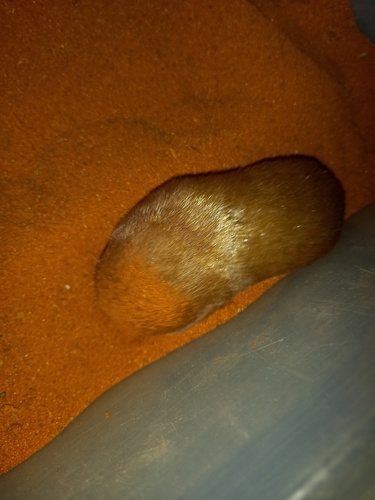
The most widespread and best-studied golden mole in southern Africa, found from sea level to over 3,000 metres. In some areas it even shares underground galleries with a very different digger, the Common Mole-rat, without either appearing to suffer. Like the other golden moles, it is blind, with eyes covered by skin, and locates its prey underground by vibration and smell, not by sight.
Compact, spindle-shaped body with no visible tail or ears, and golden fur in varying shades depending on the subspecies and locality, from dark brown to bright gold. It differs from the golden moles of the genus Neamblysomus (Gunning's and Juliana's), which are very restricted geographically, in its much wider distribution and its presence in open grassland as well as forest.
Leaves no recognisable tracks; the main sign is the ridges of raised earth marking its shallow foraging tunnels, very visible on lawns and in gardens after rain. Mounds of loose earth at the mouth of the deeper galleries, used for resting, are another sign, though a less frequent one. It can reach densities of up to 25 individuals per hectare in optimal habitat, so in such areas ridge systems can cover much of the ground.
Wide variety of habitats with diggable soil: grassland, forest, scrub and gardens, from sea level to over 3,000 m, in South Africa, Eswatini and possibly Lesotho.
Earthworms and insects and their larvae, located underground by vibration and smell.
Solitary and subterranean, although it has been recorded sharing tunnel systems with the Common Mole-rat (Cryptomys hottentotus). Digs shallow tunnels for foraging and deeper galleries for shelter and breeding.
The species maintains a large, stable population over most of its range. Some isolated evolutionary lineages with very restricted ranges could be at risk from coastal urbanisation, but this does not affect the global assessment of the species.
Coastal urbanisation fragmenting local lineages with small ranges, and use of mole poisons in gardens and farmland.
See all species accounts for tenrecs and golden moles · Full species index
Mammaling is a free app for logging the mammals you find. You record a sighting in a moment — even if it's just a track — your life list grows, and the record becomes available to scientific and conservation projects.
It runs on your phone with nothing to install. If you like, it adds to your home screen like any other app.
Open Mammaling