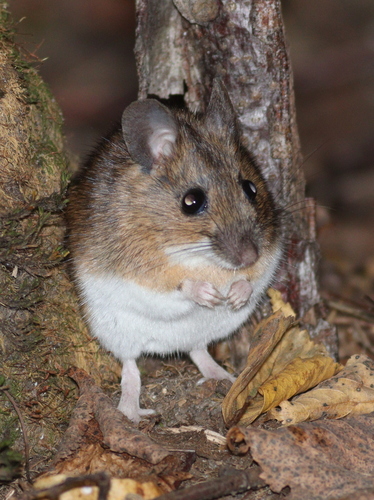
The Yellow-necked Field Mouse is a larger, more arboreal relative of the European Field Mouse. It shares much of its territory with the latter and is often confused with it at first glance. However, a band of yellow fur running across its entire chest like a complete collar reveals its identity to the observant eye.
It is an exceptional jumper and climber for its size, able to ascend trunks and branches without difficulty in search of nuts. It exploits this behaviour more effectively than its more terrestrial relative.
During the colder months, the Yellow-necked Field Mouse frequently takes refuge in human constructions near woodlands. In some regions, this makes it an occasional inhabitant of attics and country houses during winter.
A small to medium-sized rodent, the Yellow-necked Field Mouse is slightly larger than the Field Mouse. It has reddish-brown fur on its back and white on its belly. A band of orange-yellow fur forms a complete and continuous collar on its chest. This feature gives the Yellow-necked Field Mouse its name and clearly distinguishes it from the Field Mouse, in which this chest patch is smaller, diffuse, or interrupted. It also has large eyes and ears, and a long tail, almost as long as its body.
Tiny track, barely 1.5-2 cm long, with 4 fore toes and 5 hind toes. It is practically identical to the Field Mouse's, making tracks and signs alone unreliable for separating the two species. Small, elongated droppings, 5-9 mm long, are rice-grain shaped and left scattered along surface runways and in burrows. The Yellow-necked Field Mouse is more arboreal than the Field Mouse. Its caches of gnawed nuts, which have a clean, smooth-edged hole, therefore appear more frequently in tree hollows and high branches. In winter, it can be detected by nocturnal noises in attics and roofs of buildings near woodland.
Mature deciduous and mixed woodland, preferring areas with abundant nuts such as beech, oak, and hazel, from lowlands to mid-mountain areas.
Distributed throughout much of central and eastern Europe, with a more limited and fragmented presence in the southwest of the continent.
Omnivorous, feeding predominantly on nuts and seeds. Its diet is supplemented with invertebrates, shoots, and fungi according to seasonal availability. It shows a greater tendency to climb for food than the Field Mouse.
Solitary or in small, loosely structured groups. Mainly nocturnal, with breeding peaks in spring and autumn. The Yellow-necked Field Mouse is more arboreal and somewhat more associated with mature woodland with nuts than the Wood Mouse. It shares habitat with the Wood Mouse over much of its range, but does not directly compete for the same type of resource.
It maintains large and generally stable populations throughout most of its range, with marked annual fluctuations linked to the availability of mast in the forest, showing no signs of widespread decline.
Loss of mature forest with nut-producing species, intensive forest management reducing the availability of this key resource, and use of rodenticides in agricultural areas near the forest.
See all species accounts for rodents · Full species index
Mammaling is a free app for logging the mammals you find. You record a sighting in a moment — even if it's just a track — your life list grows, and the record becomes available to scientific and conservation projects.
It runs on your phone with nothing to install. If you like, it adds to your home screen like any other app.
Open Mammaling