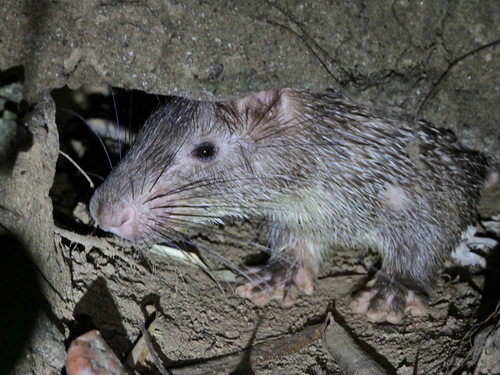
A short-spined Asian porcupine that, unlike its long-spined relatives, shakes the hollow end of its tail like a kind of rattle to scare off potential predators.
Elongated body up to 57 cm long and about 4 kg in weight, covered in short, pale-tipped spines rather than the long spines of other porcupines. The tail is long, naked and scaly, ending in a tuft of hollow white hair that it uses as a rattle.
Digs burrows that can hold up to eight individuals of the same family group, sharing common paths, latrines and feeding areas. It also shelters in crevices, termite mounds, gaps among roots and caves.
Subtropical and tropical montane forest, cultivated areas, riverine forest and forest islands, from eastern India to central-southern China and the Malay Peninsula, up to 3000 m altitude.
Herbivorous and opportunistic omnivore; it can feed to excess on crops such as cassava in nearby farming areas.
Lives in family groups of up to eight individuals sharing a burrow, paths and latrines. Forages alone at night although it shelters as a group by day; very cautious and silent when it goes out to look for food.
Widely distributed species that is still locally common, although with local declines documented owing to intensive hunting for food.
Excessive hunting for meat in some parts of its range.
See all species accounts for rodents · Full species index
Mammaling is a free app for logging the mammals you find. You record a sighting in a moment — even if it's just a track — your life list grows, and the record becomes available to scientific and conservation projects.
It runs on your phone with nothing to install. If you like, it adds to your home screen like any other app.
Open Mammaling