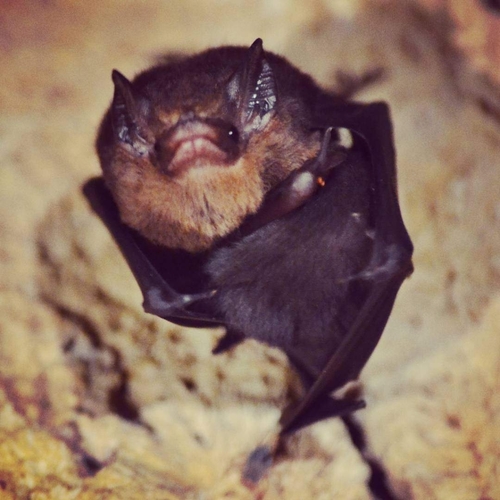
Thomas's Sac-winged Bat is a tiny bat belonging to the Emballonuridae family. This group is characterised by a small glandular sac on the wing, which males use to accumulate odorous secretions for social communication. In Thomas's Sac-winged Bat, however, this feature is less conspicuous than in some relatives.
It lives in colonies occupying rock crevices, small caves, and volcanic hollows in areas of dry tropical forest in Mesoamerica. They form compact groups, resting pressed against each other on the refuge wall.
It is the smallest species in its genus. Unlike its more widespread relative, it lacks the whitish wing membrane edge that makes the latter so easy to recognise in hand.
Thomas's Sac-winged Bat is a very small bat, the smallest of its genus. It has uniform greyish-brown fur and lacks the whitish wing membrane edge found on its more widespread relative. Its narrow wings are adapted for fast, direct flight. It differs from its main relative precisely by the absence of that pale wing edge and its somewhat smaller size.
Dry tropical forest and open vegetation areas with rocky outcrops and small caves, from lowlands to low mountain areas. Distributed across a strip of Mesoamerica that includes southern Mexico, Belize, and Guatemala.
Insectivorous, Thomas's Sac-winged Bat hunts small flying insects in fast, direct flight over areas of open vegetation close to its roost.
It forms breeding colonies in rock crevices and small caves, with individuals resting very close together on the wall of the roost. Its reproductive and social biology is poorly known compared to better-studied bat species.
Its populations are considered to be in decline. It has a fragmented distribution and is sensitive to the loss of the dry tropical forest on which it depends, one of Mesoamerica's most threatened ecosystems.
Loss and fragmentation of dry tropical forest due to agricultural and livestock expansion, and alteration or destruction of roosts in caves and rock crevices.
See all species accounts for bats · Full species index
Mammaling is a free app for logging the mammals you find. You record a sighting in a moment — even if it's just a track — your life list grows, and the record becomes available to scientific and conservation projects.
It runs on your phone with nothing to install. If you like, it adds to your home screen like any other app.
Open Mammaling