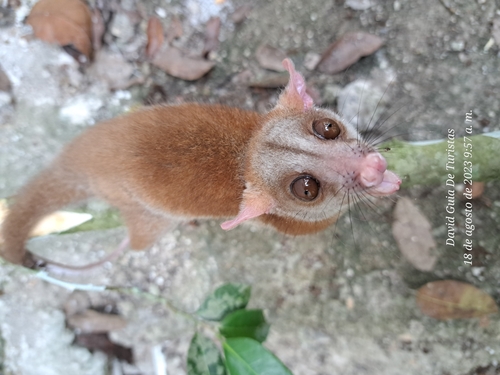
It is a treading marsupial that passes virtually all his life in the wet rainforest dosel, moving between branches with the help of a long-tailed prensil tail and large eyes and very adapted to the night vision that give him an appearance of almost a small primate. Unlike the most terrestrial rainforests of America, it rarely descends to the ground, and its dense lanous fur, from which it takes its common name, distinguishes it from the rest of the American marsupials of lighter appearance. It lives in Mesoamerican tropical wet rainforest and the northwest of South America, where its varied fruit diet, nectar and invertebrate turns it into a seed dispersor and an octial pollinator of certain importance for backbone vegetation.
A medium-sized marsupial, dense brown-roasted lanous fur, with a dark mask around the eyes and a dark line that runs through the center of the back, and partially naked long prensil tail on the tip. It differs from other zarigüeyas in its area by that notably lanous and dense fur, very different from the shorter and smoother fur of the rest of American marsupials, and by its strictly arboricular habits.
Footprint with 5 fingers on each foot, the rear thumb opponible and nailless, 3-4 cm, rarely visible when moving almost always by the dosel without touching the ground. Irregular and soft excretions, with remains of fruit and insect visible, deposited scattered on branches or on the base of trees used frequently.
Tropical rainforest and transitional forest, from low lands to middle mountain heights. Distributed from southern Mexico to northwestern South America.
Omnivorous, it feeds on fruit, nectar, insect and occasional egg, foraging almost entirely in the forest bottom.
Solitary and strictly arboric habits, nighttime activity, rarely descends to the ground.Like the rest of American marsupials, the breasts complete much of their development within the mother's marsupial stock after being born in a very immature state.
Its populations are generally considered stable in most of its area of distribution, although locally it is sensitive to the loss of continuous mature forest.
Deforestation and fragmentation of wet rainforest by agricultural and livestock expansion.
See all species accounts for opossums · Full species index
Mammaling is a free app for logging the mammals you find. You record a sighting in a moment — even if it's just a track — your life list grows, and the record becomes available to scientific and conservation projects.
It runs on your phone with nothing to install. If you like, it adds to your home screen like any other app.
Open Mammaling