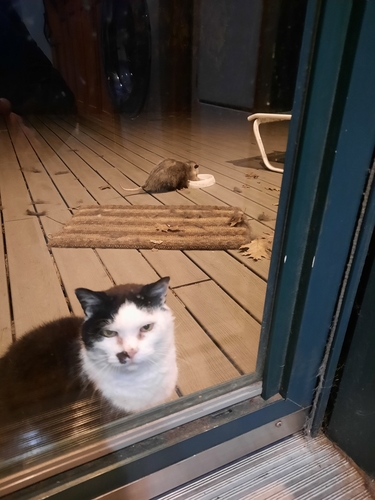
He is the only native marsupial native of North America to the north of Mexico, a lonely survivor of a lineage that has diversified much more in the rest of the continent, and one of the few American mammals able to pretend dead in such a convincing way that he has given name to a popular English expression to describe that behavior. When he feels curled, he can fall into a state of involuntary immobility accompanied by babeo and a putrid smell released by anal glands, a defense mechanism that can last from minutes to several hours and that is not under the conscious control of the animal, unlike what popular expression suggests. He lives in a wide variety of habitats, from forest to urban zones, where his omnivorous and opportunistic diet allows him to survive eating from fruit to insects, carrot or
A medium-sized marsupial, gray-haired fur with white face, pink-pointed fox, naked black ears, and long and naked rat-looking prensil tail. It differs from any other North American mammal by being the only marsupial in the region, with its naked prensil tail and white pointed fox as unmistakable traits.
Fingerprint with 5 fingers on each foot, opposite and nailless rear thumb, a unique trait among American mammals, 5-6 cm. Irregular and soft excrete, with visible fruit, insect or bone remains, left scattered without fixed pattern, often near garbage sources in urban areas. It leaves garbage marks when climbing trunks and bushes, and can leave a dragging mark of its pressile tail in soft substratum next to the foot trace.
Very varied, from forest and meadows to urban and periurban areas, from lowlands to middle mountain areas.Distributed by much of North America, from southern Canada to Central America, with an area of distribution expanding to the north in the last decades.
Opportunist omnivore, he feeds on fruit, insect, small vertebrates, eggs, carrot and human food remains, adapting his diet to the available resources in each habitat.
Solitary and nocturnal activity, with a characteristic marsupial reproductive behavior: the offspring complete much of their development within the mother’s marsupial bag after being born in a very immature state.
Its populations are considered stable and expanding to the north of its historical distribution area, favored by its great ability to adapt to habitats altered by humans.
It does not face significant species-level threats; locally suffers road crashes, one of the main documented causes of mortality.
See all species accounts for opossums · Full species index
Mammaling is a free app for logging the mammals you find. You record a sighting in a moment — even if it's just a track — your life list grows, and the record becomes available to scientific and conservation projects.
It runs on your phone with nothing to install. If you like, it adds to your home screen like any other app.
Open Mammaling